

Xenolalia
Reflecting on the Sounds of Pentecost

During the Great Feast of Weeks, or Pentecost (Leviticus 23:15-21), Christ’s disciples gathered together. The sound of a “rushing mighty wind” (Acts 2:2, Lamsa) alerted each to a gift Jesus had promised. Before the Lord’s ascension, He reminded them: “you will receive power when the Holy Spirit has come upon you; and you shall be My witnesses both in Jerusalem and in all Judea, and Samaria, and as far as the remotest part of the earth” (Acts 1:8, NASB). William de Brailes, a thirteenth-century illuminator in Oxford, imagined their meeting interrupted by the Holy Spirit’s arrival (illustrated below).1 God announced this momentous event with sound. What thousands heard that day echoes in our own time across the globe.
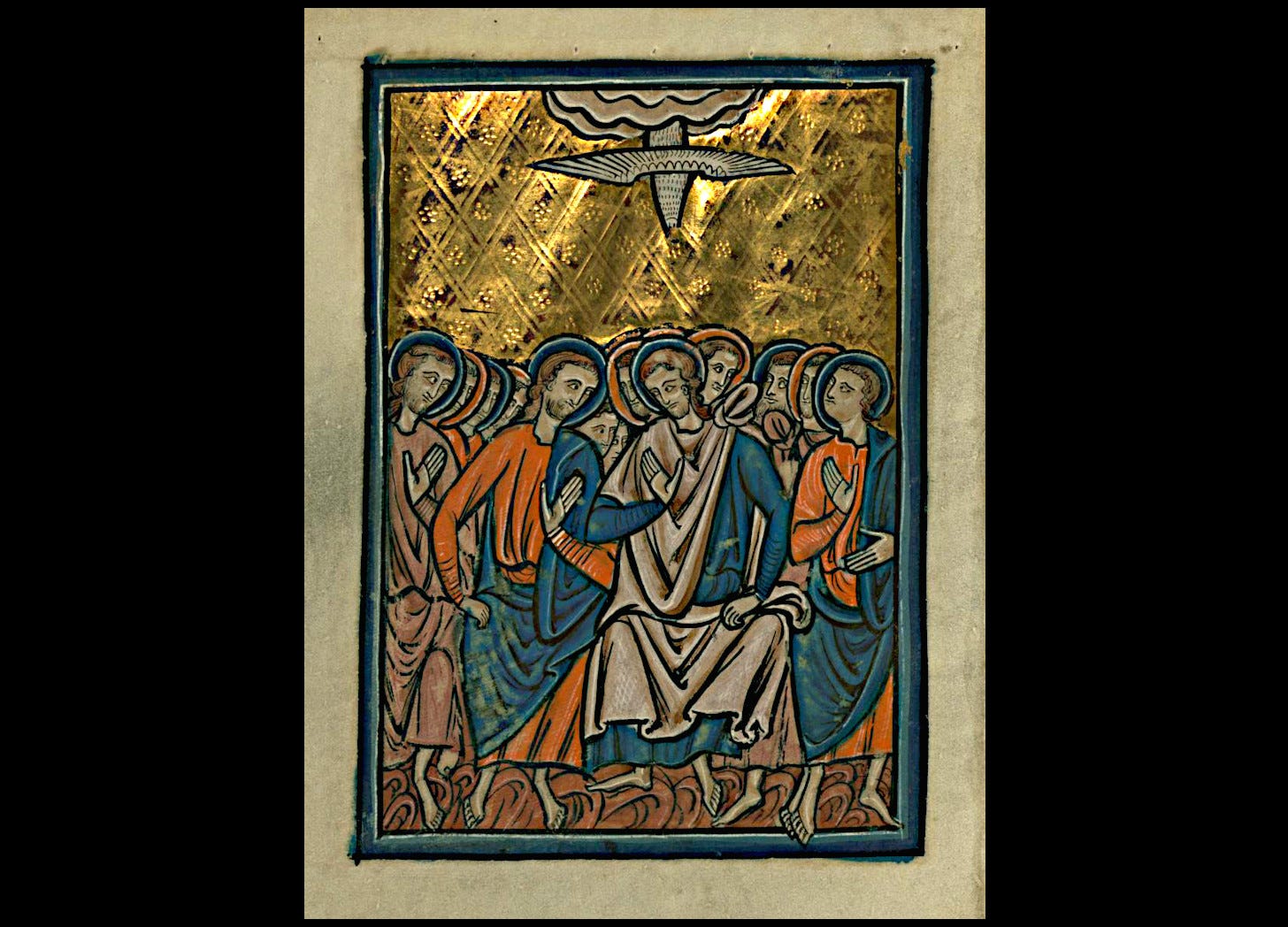
De Brailes articulated wings across the back of a large-scale dove, descending from a wavy cloud bank on high. Although later damage to the miniature has obscured the bird’s head, turning a visual representation of the Holy Spirit away from the painting’s viewers reveals a singular focus on Jesus’ depicted followers. Disciples look up, down, or try to catch the eyes of their companions. The undulating cloud and wave-like floor design visually evoke atmospheric disturbance in the account: “a sound from heaven like the roaring of a mighty windstorm … filled the house where they were sitting” (Acts 2:2, NLT).2
Centuries later, an Italian artist painted the next moments (see below).3 Eleven fiery tongues radiate from the descended Holy Spirit’s dove-shaped form (Acts 2:3). This dove’s halo has red line decoration, using a pattern of diagonals. It contrasts with the cross nimbus many artists of that era painted to distinguish Jesus. The Third Person of the Trinity’s outstretched wings overshadow the disciples. While using the beak’s outline to point toward the man with a gray beard, who is traditionally identified as the Apostle Peter (note front center left), the illuminator represented the Holy Spirit on full display for the viewer.
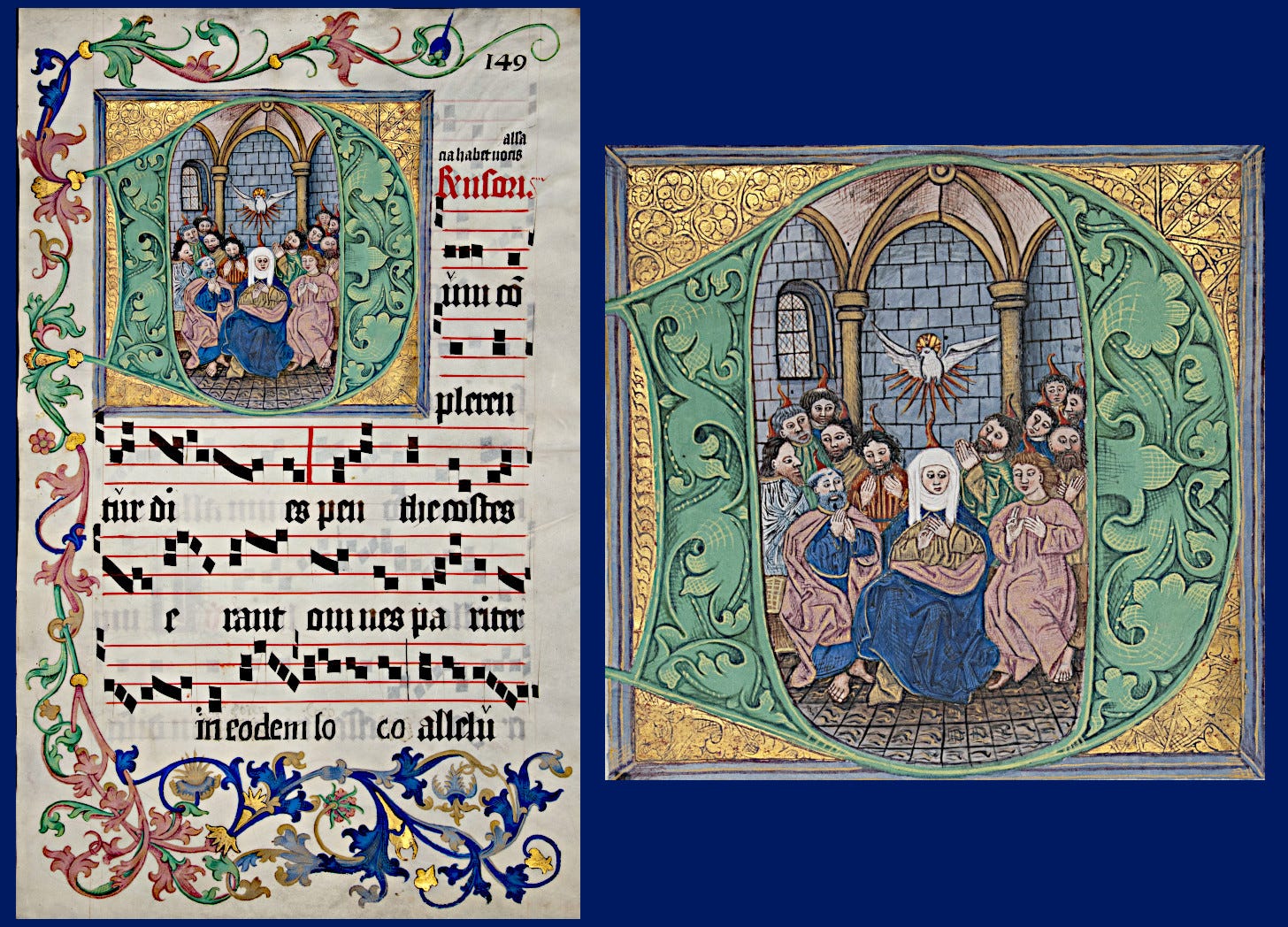
The disciples’ mouths are all still closed, but an elaborate code of gestures helps reveal the figures’ minds. Most are shown with raised or clasped hands. A disciple at extreme right, whose beard overlaps with the initial that frames this scene, has crossed his hands above his heart as a sign of submission to God’s will.
Next to this man’s quiet acceptance sits a youthful depiction of the Apostle John and the centrally-placed Virgin Mary. They exchange both glances and complicated hand gestures typically associated with speaking. Whether or not we are supposed to imagine a silent or conversational episode, this dramatic moment illustrated when: “They were all filled with the Holy Spirit and began to speak with other languages, as the Spirit gave them the ability to speak” (Acts 2:4, WEB). Spontaneous, previously unlearned utterances in a foreign language are part of the phenomenon called xenolalia.
Pentecost’s sounds shifted from a stirring wind to mother tongues used on three continents.4 This linguistic miracle’s diverse, intended audience could not resist. More congregated among the “… devout people from every nation under heaven [in Jerusalem]. When this sound occurred, a crowd came together and was confused because each one heard them speaking in his own language” (Acts 2:5b-6, CSB). Puzzled, they asked their companions: “How is it then that each of us hears them in his own native language?” (Acts 2:8, MSB)
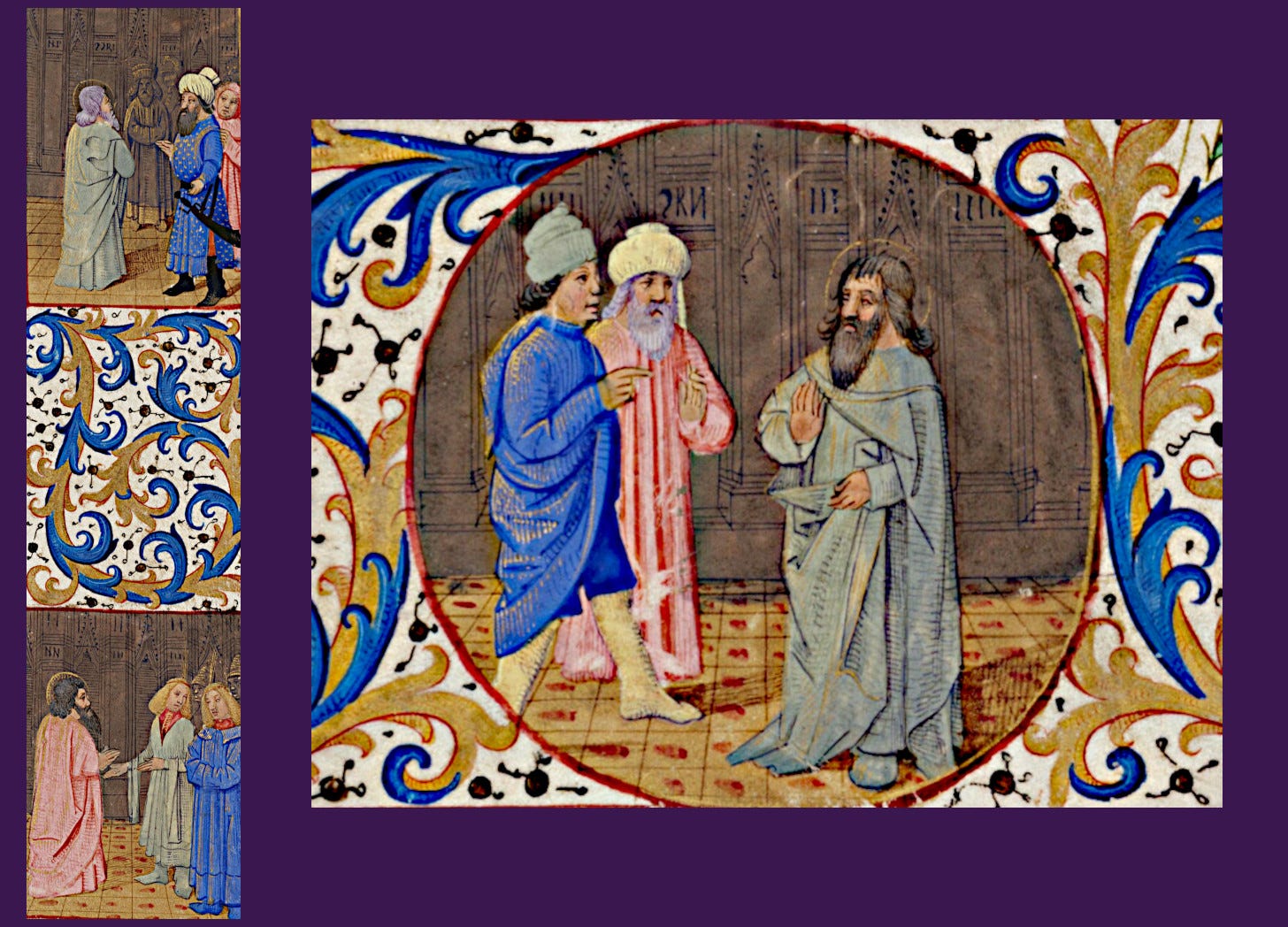
A fifteenth-century French illuminator envisioned individual disciples speaking to small groups (photograph above).5 One gray-bearded follower of Jesus engages with a man who carries an elaborately curved sword and wears a light-yellow turban. Another exchanges gestures with the closest of two blonde-haired men, while his companion keeps both hands tucked into long blue sleeves. The right roundel’s three figures use their hands to signal both communication and response. These miniatures point toward the crowd’s varied reactions. Some understandably remained skeptical, but: “… all were amazed and perplexed, saying to one another, ‘What does this mean?’” (Acts 2:12, ESV)
Which heart languages were part of Pentecost’s unprecedented sound? Since the Biblical passage cited territories and people groups (Acts 2:9-11), there is room for interpretation. We can be certain that inhabitants of lands from all four cardinal directions were involved. Persians and Romans came from the east and west, respectively. A significant percentage of Anatolians, from north of Jerusalem in Asia Minor, were utilizing Greek dialects by Jesus’ time. Visiting from the south, Copts and Arabians were present.
Recognizing that the cacophony of hearing over a dozen languages at once was confusing, the Apostle Peter decided to give his first sermon. To interpret this manifestation of the Lord’s power, he quoted the Prophet Joel: “In the last days, God says, I will pour out My Spirit on all people” (Acts 2:17a, BSB; also Joel 2:28-32). Peter underscored that this event was only one aspect of God’s plan: “And I will perform wonders in the sky above and miraculous signs on the earth below” (Acts 2:19a, NET Bible). In keeping with Pentecost’s uniquely inclusive use of vernacular communication across their known world, Peter echoed Joel’s vision of welcoming folks from all over into God’s family: “Then everyone who calls on the name of the Lord shall be saved” (Acts 2:21, NRSV).
Thousands of vernacular Bible translations have been recorded and made available for free via the internet.6 Even though languages change over time, layering readings of Acts 2:1-41 posted online would provide a limited taste of Pentecost’s supernatural sound in Hebrew, Aramaic, Greek, Latin, Coptic, Persian, and Arabic. If you would like to share a Scripture recording you appreciate or respond in a different way, please comment below.
Many thanks for the public domain image courtesy of Baltimore’s Walters Art Museum, MS W.106, f. 22v, circa 1250; https://art.thewalters.org/object/W.106.22V/, accessed May 2026.
On the verso of the following manuscript illustration, please find the Vulgate translation of this text; Lilly Library, Indiana University, Bloomington, Ricketts MS I5; fifteenth-century Italy: https://digitalcollections.iu.edu/concern/archival_materials/dv141m10x, accessed May 2026.
Grateful for the public domain photograph courtesy of the Lilly Library, Indiana University, Bloomington, Ricketts MS I5: https://digitalcollections.iu.edu/concern/archival_materials/dv141m10x, accessed May 2026.
A clear map showing these regions is available online: https://www.esv.org/resources/esv-global-study-bible/map-44-02/, accessed May 2026.
New Haven, MS 425, f. 183r; 1470s, Tours, France. Thankful for this image courtesy of the Beinecke Rare Book and Manuscript Library, Yale University; https://collections.library.yale.edu/catalog/32465651, accessed May 2026.
Please search for resources on www.fivefish.org and www.ScriptureEarth.org, accessed May 2026.
I can only add that St. Thomas preached in Aramaic when he reached India. I have always wanted to know how many languages were spoken in that room.
God also always provides the means to execute the call He gives us.