

Ohio
Episodes in U.S. Bible History

Ohio entered the union on 1 March 1803. Rather than discuss their region’s 1825 New Testament or first complete Bible from Cincinnati in 1830,[i] this newsletter will highlight nineteenth-century works printed in Ohio along with manuscript fragments kept there. Each witness connects to the Good Samaritan parable that Jesus told (Luke 10:25-37).
The Ohio State University’s Rare Books and Manuscripts Library conserves a significant number of leaves removed from an early thirteenth-century Parisian copy of Scripture, known as the Hornby-Cockerell Bible (illustrated below).[ii] Specialists have been working to piece its folios back together. This Gospel book’s opening author portrait is framed by an initial Q with a dragon-shaped descender. Inside, the Evangelist Luke appears to hold a single sheet of parchment on his precariously slanted desk. He is not drafting, but reflecting in a manner similar to the opening verse: “… many have undertaken to compile a narrative …” (Luke 1:1, ESV).
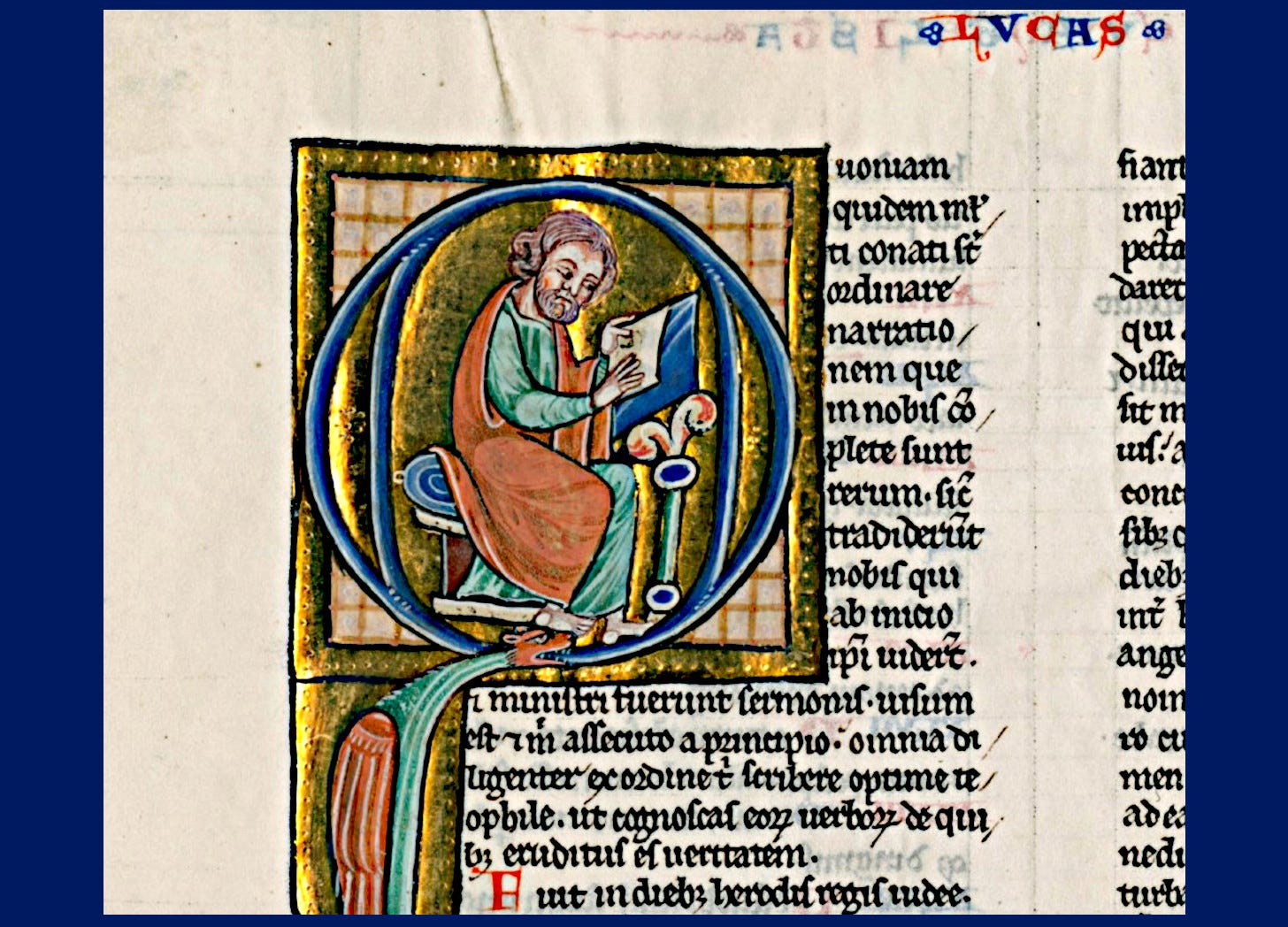
Luke is the only Gospel writer who preserved Christ’s Good Samaritan story. OSU has the Hornby-Cockerell Bible’s text leaves that include this account.[iii] A religious expert asked Jesus: “Who is my neighbor?” (Luke 10:29b, WEB) The Lord shared His parable about how several spiritual leaders avoided a man who had been robbed and left for dead on the road to Jericho. Finally, a Samaritan helped support the robbery survivor’s full recovery. Christ recognized the Samaritan as a good neighbor and invited His listeners to “Go and do likewise” (Luke 10:37b, BSB). Experts reuniting this broken manuscript’s fragments are engaged in literally or virtually binding these dispersed primary sources together.
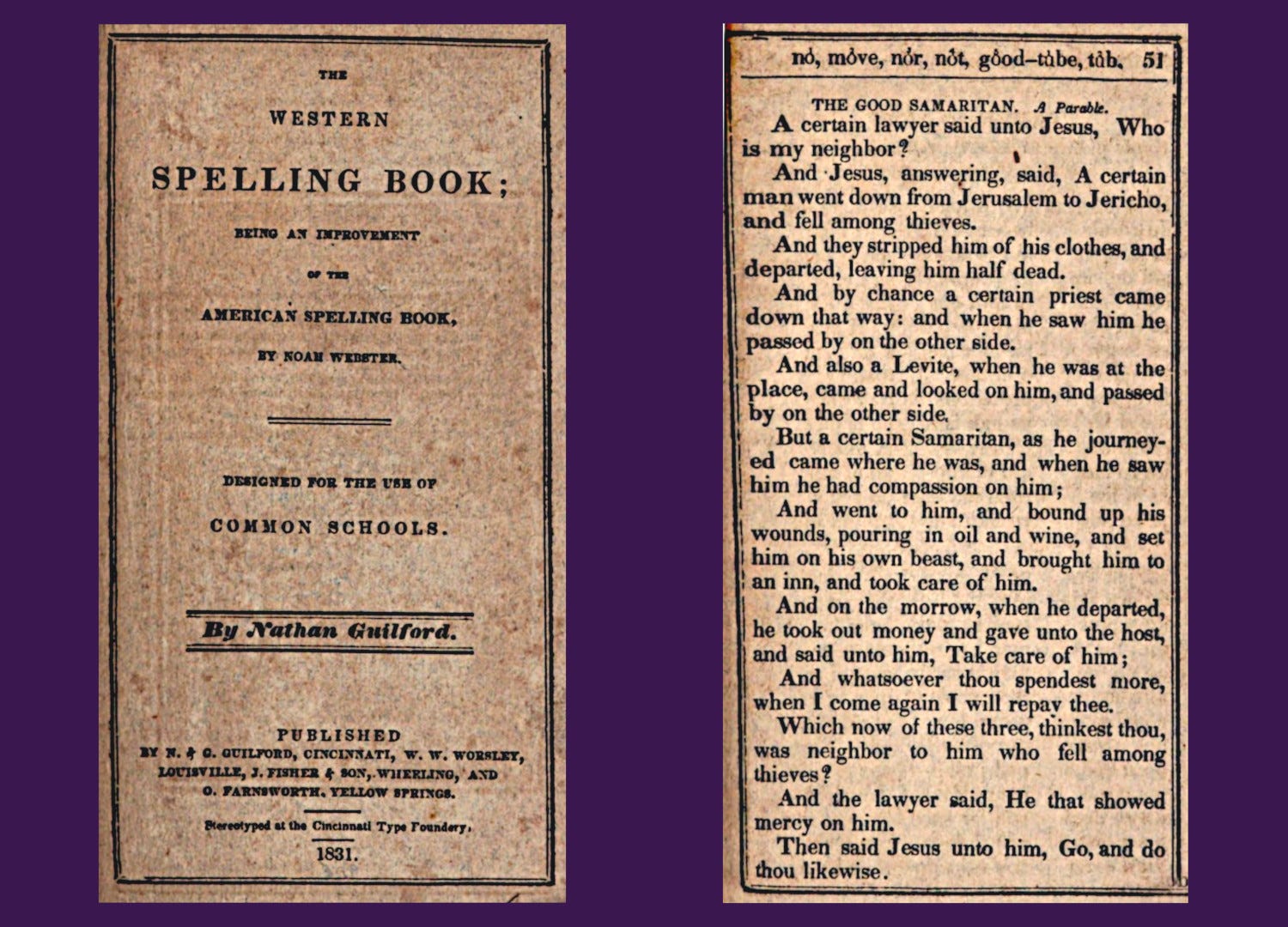
One of the printers responsible for Ohio’s 1830 Bible project, Nathan Guilford (1786-1854),[iv] published another widely-used title in 1831: Noah Webster’s Western Spelling Book (images above).[v] Along with grammar guidance, word lists, and short sentences, Webster utilized brief reading exercises. The Good Samaritan account was mixed in among elements to memorize and paragraphs clarifying definitions of spelling words. Perhaps using moral tales, like Jesus’ famous illustration, in addition to short vignettes that taught language learners to respect their parents and behave increased the popularity of Webster’s textbook.
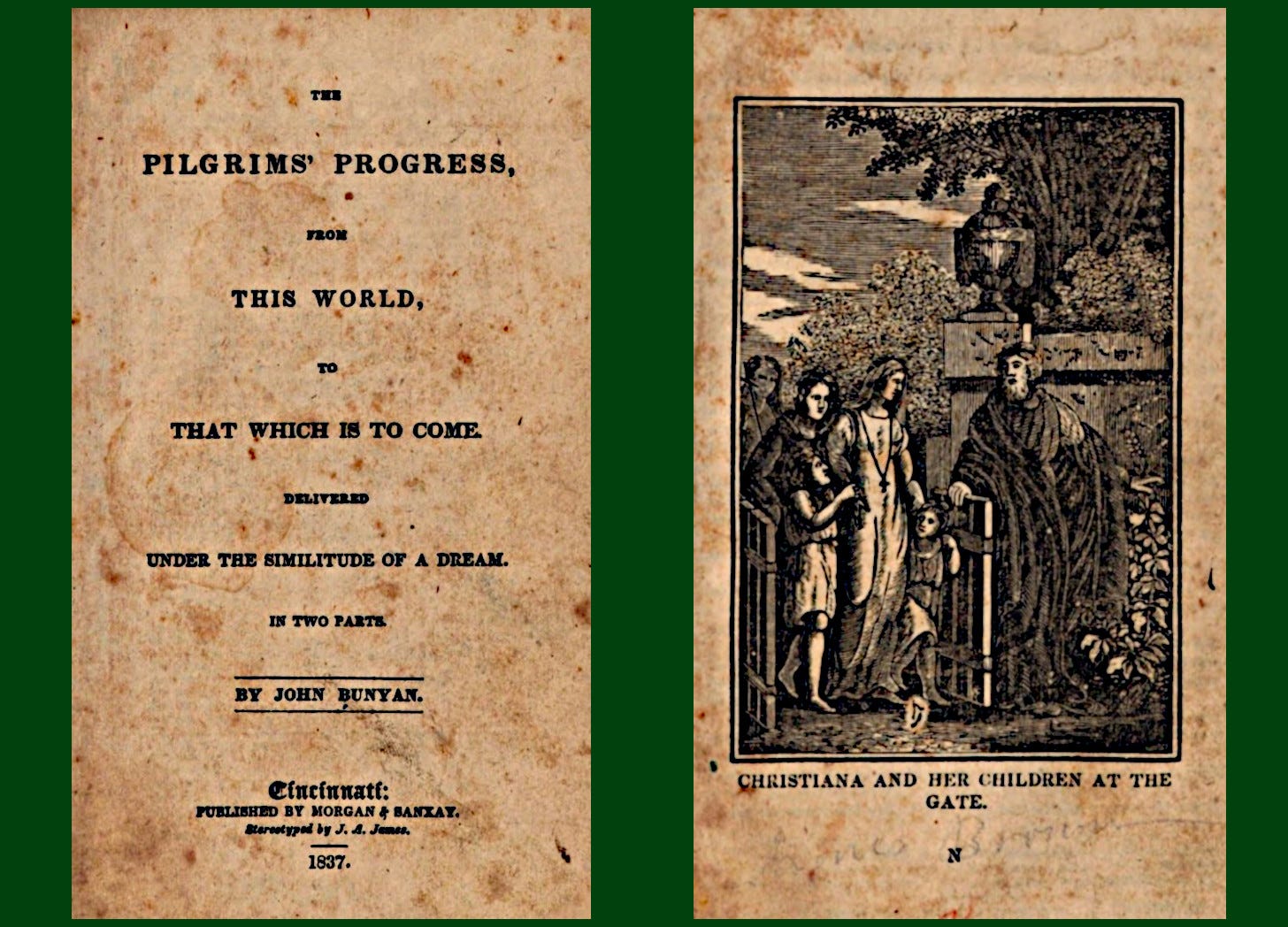
Ephraim Morgan (1790-1873) and Frederic Sanxay (1791-1875), two publishing partners involved with the 1830 Cincinnati edition of Scripture, printed John Bunyan’s (1628-88) Pilgrim’s Progress in 1837 (see above left).[vi] This famous allegory of the Christian life follows Pilgrim Christian as well as his wife Christiana and their children on journeys from the City of Destruction to the Celestial City. Many characters help these sojourners, but perhaps the closest to the Good Samaritan in Jesus’ teachings is Mr. Great-Heart. In Part II, the Interpreter connected this strong protector with Christiana after she passed through the narrow Wicket Gate (illustration above right).[vii] He led the group. Eventually, they spent time with Gaius, who never charged pilgrims but “looked for his pay from the good Samaritan” like the Biblical innkeeper (Luke 10:35).[viii] Great-Heart outlined his rescuing practices in a speech to Mr. Feeble-Mind: “I have it in commission to comfort … and to support the weak. … [W]e will wait for you; we will lend you our help; … we will be made all things to you, rather than you shall be left behind.”[ix] Thinking first of others’ needs echoes the Samaritan’s generous sacrifices (Luke 10:33-34).
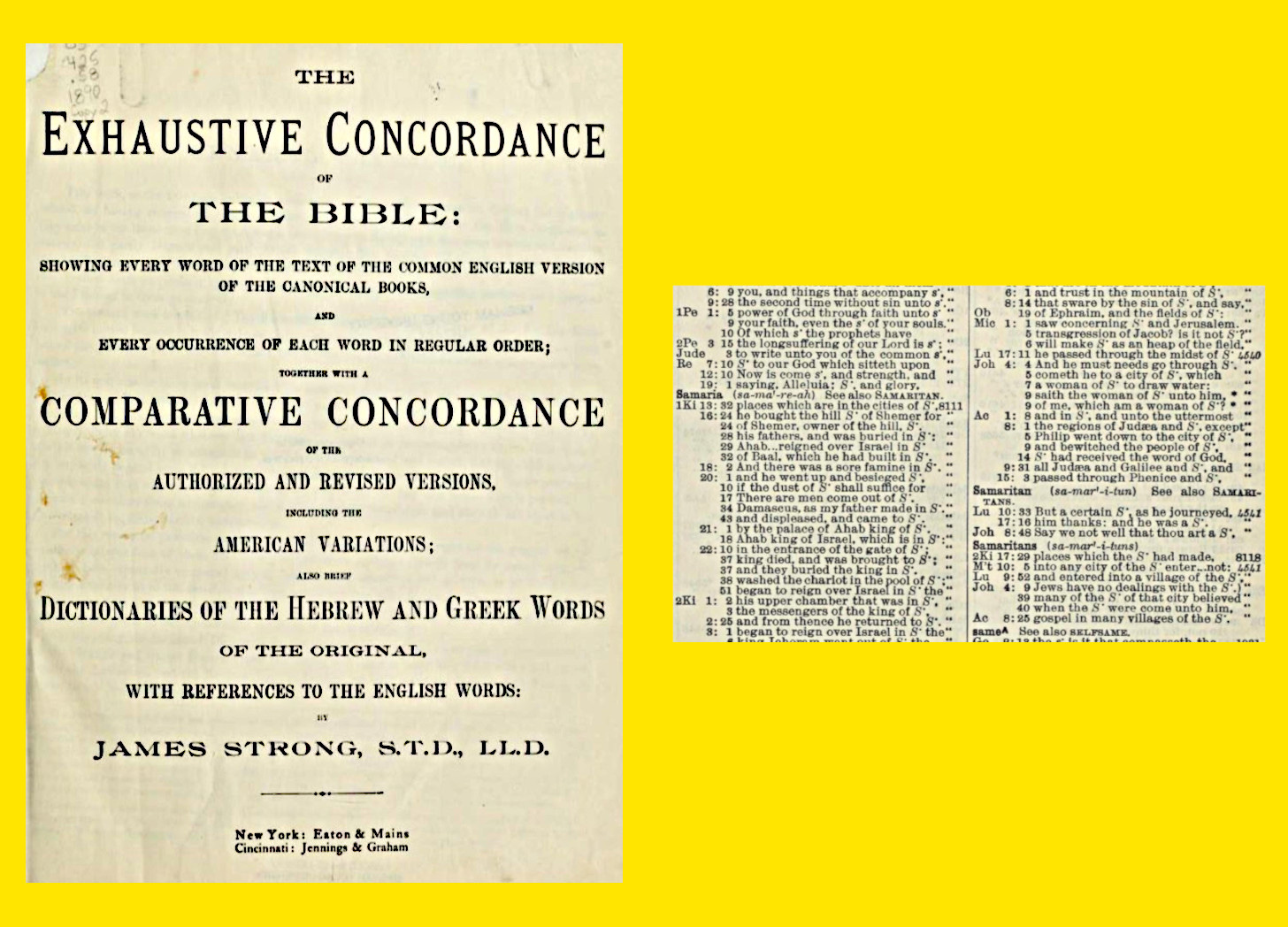
Among the most useful Scripture study aids is a concordance, which identifies every time a particular word appears in each Biblical book. An 1890 version of this resource was printed in both New York and Cincinnati: James Strong’s Exhaustive Concordance of the Bible (photographs above).[x] Entries for “Samaria,” “Samaritan,” and “Samaritans” help trace the long history of division between the Israelites and their neighbors from these words’ appearances in I Kings through Acts.[xi] The final Biblical reference appears to note believers encountered while passing through Samaria (Acts 15:3), suggesting that some Samaritans came into fellowship. Jesus’ parable encouraged kindness, healing, and restoration to increase hope.
Investment during the early Nineteenth Century brought stereotype plate production to Ohio, benefitting budget-conscious readers. By reducing labor costs, stereotyping facilitated access to many popular works. Webster’s Western Spelling Book, above, was printed with stereotyped plates from the Cincinnati Type Foundry. By the 1860s, this process had been used in Boston, New York, Philadelphia, and Cincinnati.[xii] It constituted a major distinction, particularly for any city west of the Appalachian Mountains. If you would like to mention other examples from Ohio Bible history, please add a post. I also invite comments sharing your thoughts about this material.
[i] Margaret Hills, ed., The English Bible in America (New York: American Bible Society and New York Public Library, 1961) pp. 83 and 106, no. 536 and 702; see also https://search.worldcat.org/title/5804253 and https://search.worldcat.org/title/950920456, accessed April 2026.
[ii] Read Eric Johnson’s article in Manuscript Studies, vol. 4, no. 2 (Fall 2019) pp. 270-333, especially 297-99 and 324, at: https://repository.upenn.edu/entities/publication/753bbaf0-a499-404c-b800-31ee814ace11, accessed April 2026. Many thanks for the photograph of this public domain work on p. 301.
[iii] Ibid., p. 324.
[iv] He was born Nathaniel; see https://www.findagrave.com/memorial/28337656/nathaniel-guilford, accessed April 2026.
[v] For background, see https://catalog.hathitrust.org/Record/008619592 and https://vernacularbibleexplorer.substack.com/p/connecticut. The Good Samaritan story appears on p. 51. Grateful for public domain scans: https://babel.hathitrust.org/cgi/pt?id=nyp.33433069253312&seq=7 and https://babel.hathitrust.org/cgi/pt?id=nyp.33433069253312&seq=55, accessed April 2026.
[vi] Theodore Sanxay, The Sanxay Family (New York 1907) pp. 104-106 in: https://www.seekingmyroots.com/members/files/G005710.pdf. Appreciate the public domain illustration here: https://babel.hathitrust.org/cgi/pt?id=umn.31951002070814c&seq=11, accessed April 2026.
[vii] Thanks for a public domain photograph online: https://babel.hathitrust.org/cgi/pt?id=umn.31951002070814c&seq=153&view=1up, accessed April 2026.
[viii] https://www.ccel.org/ccel/bunyan/pilgrim.v.viii.html, accessed April 2026.
[ix] https://babel.hathitrust.org/cgi/pt?id=umn.31951002070814c&seq=209 and https://www.ccel.org/ccel/bunyan/pilgrim.v.viii.html, accessed April 2026.
[x] Appreciate the public domain images at: https://archive.org/details/exhaustiveconcor1890stro/page/n11/mode/2up and https://archive.org/details/exhaustiveconcor1890stro/page/874/mode/2up, accessed April 2026.
[xi] Find entries in Strong’s on 874. Ancient Israel divided into two kingdoms (I Kings 12) before the first Biblical use of “Samaria” in I Kings 13:32.
[xii] See pp. 165 and 351 in: https://dn790007.ca.archive.org/0/items/newhistoryofster00kubl/newhistoryofster00kubl.pdf. Another example of American printing that relied on plates is found at: https://vernacularbibleexplorer.substack.com/p/biblical-printing-spotlight, accessed April 2026.
Luke in the Q made me forget this was the beginning to actual writing!
I've been looking forward to your Ohio piece, and enjoyed that you chose the Good Samaritan was your thread to stich the printings together. Out of curiosity, what does the Q-initial Luke sits inside signify? The author's name?