

Maine
Episodes in U.S. Bible History

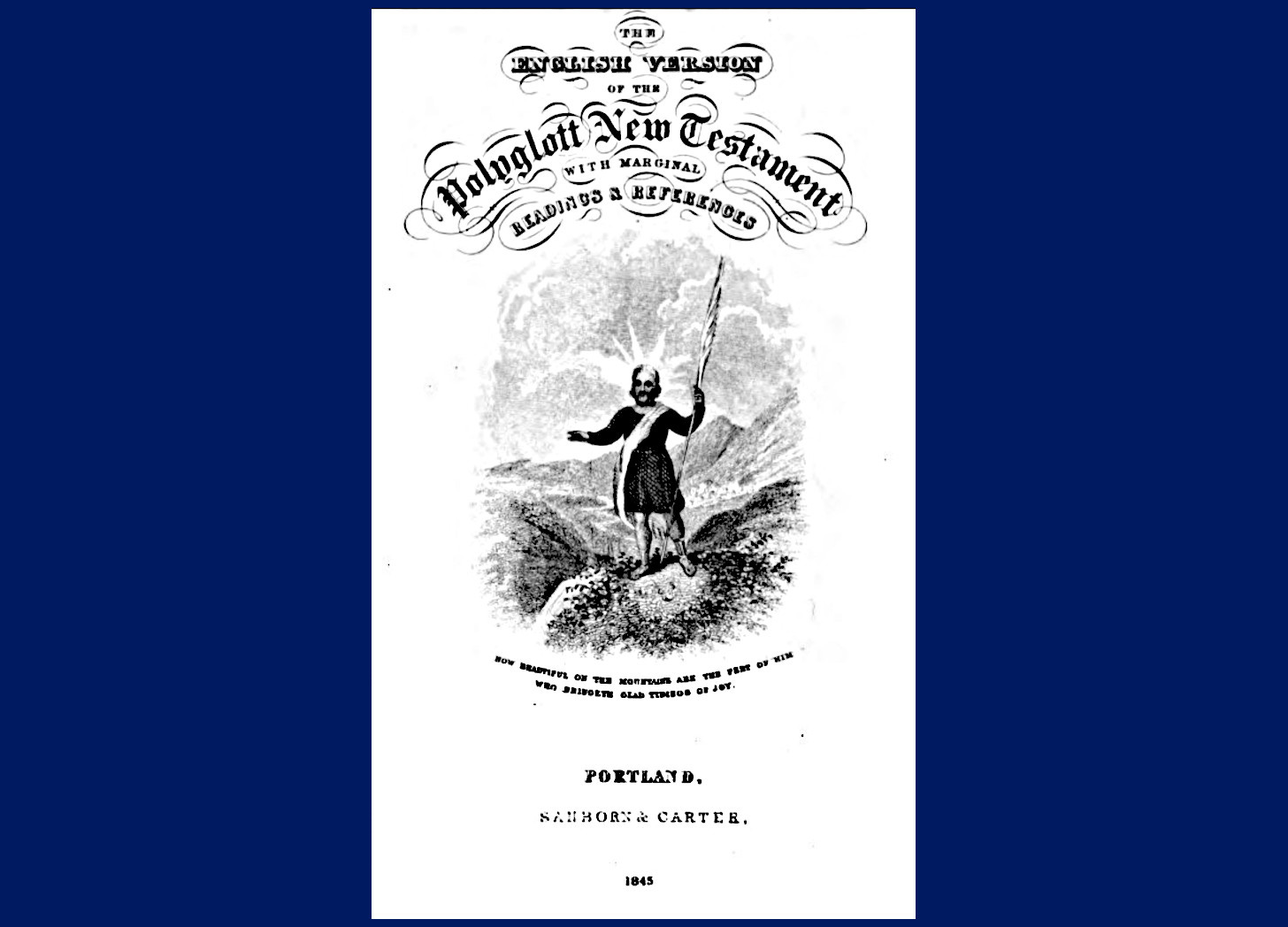
Maine entered the union on 15 March 1820. Formerly a part of Massachusetts, this region benefitted from its ties to the Cambridge-Boston area’s early and prolific printers of Biblical sources.[i] Within fifty years of American independence, Parker Sheldon (a. 1820s-30s) published a New Testament in Gardiner (1826).[ii] Oliver Sanborn’s partnerships (a. 1830s-60s) printed several Scripture editions.[iii] Sanborn & Ezra Carter Jr. (1773-68) produced an English-only version of the Polyglott Bible (1845).[iv] Multipart frontispieces for both Testaments include a man who personified bringing Good News (Romans 10:15; image above).[v] While these early copies of Scripture from Maine support standard narratives about East Coast printing history, several other examples reveal more unique witnesses.
Perhaps the most colorful entry from Margaret Hills’s The English Bible in America characterized a Maine translator. Jonathan Morgan (1778-1871), according to Hills, “was a lawyer and inventor in Portland … best remembered as an eccentric who wore a weird wide hat, a long cloak, and huge goggles … He loved to ask questions that were very difficult to answer.”[vi] Morgan’s patented coffee grinder proved successful by comparison to his steamboat experiments, which involved voyages on the Kennebec River.[vii] Hills’s summary of Morgan’s efforts rings true: “while his inventions were ingenious, he did not perfect … or profit from them.”[viii] Decades after those failures, Morgan submitted designs for a new steamboat the year of his death.[ix] He was not afraid to take risks and persevere.
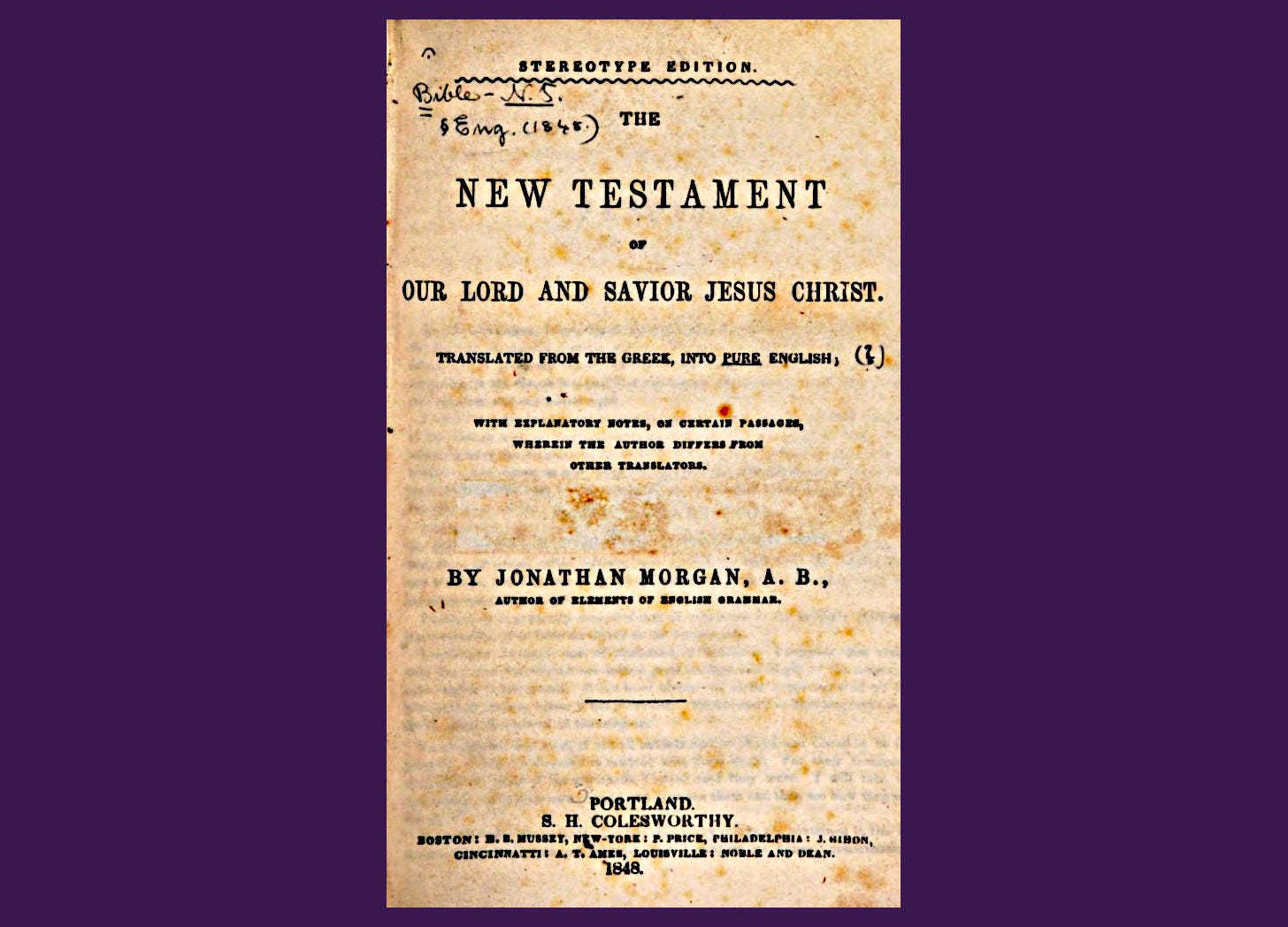
Samuel H. Colesworthy (a. 1820s-40s) planned to distribute Morgan’s version via markets beyond Portland.[x] Its title page promised dissemination in Boston, Cincinnati, Louisville, New York, and Philadelphia (illustrated above).[xi] The introduction revealed one of Morgan’s primary goals: “give the true reading … without any reference to creed or sect.”[xii] Morgan relied on the King James but, when experts disagreed, his translation kept certain terms in Greek.[xiii] His spelling reforms, such as distinguishing certain vowels with umlauts, were another curiosity.[xiv]
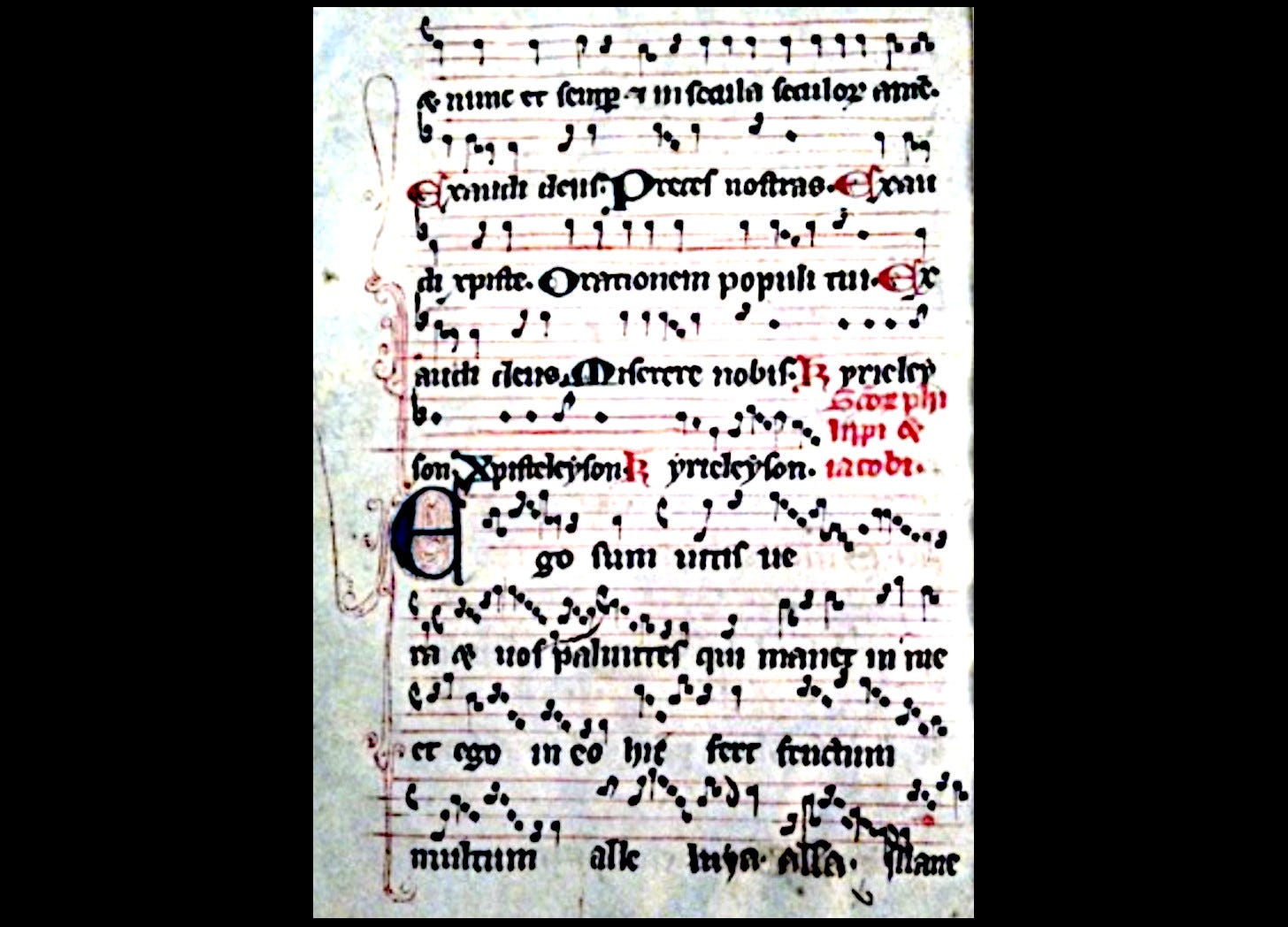
In one client’s trunk, a Maine dealer recently uncovered leaves formerly owned by Otto Ege (1888-1951), who habitually cut folios from medieval manuscripts.[xv] Colby College, overlooking the Kennebec River Valley in Waterville, is now home to some of Ege’s medieval folios. A leaf from the Wilton Processional features part of Jesus’ Upper Room Discourse: “I am the vine, you are the branches. Those who abide in me and I in them bear much fruit, because apart from me you can do nothing” (John 15:5, NRSV; photograph above).[xvi]
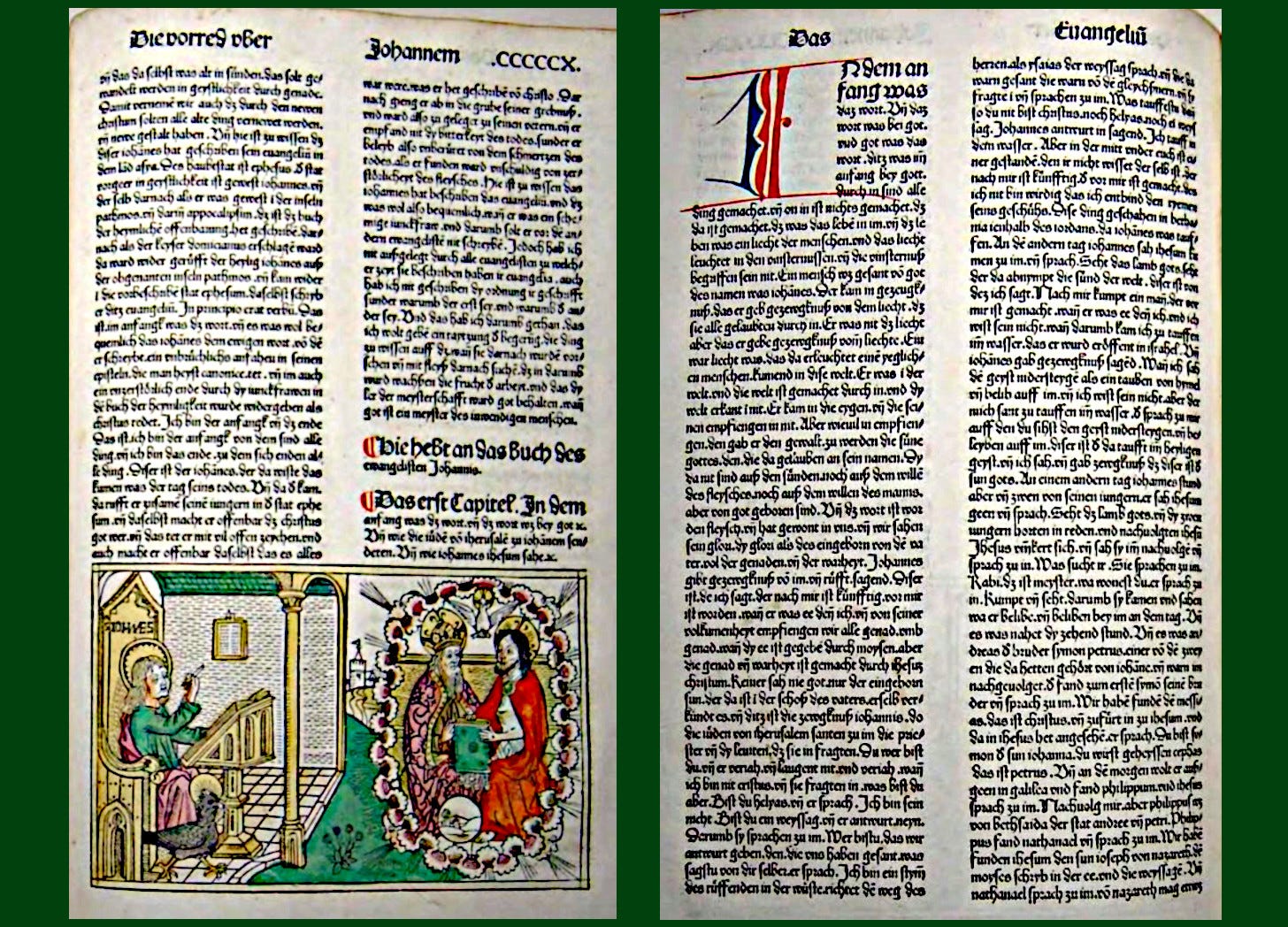
Probably the most distinctive, printed Biblical work at their Colby Museum of Art is a German-language translation of Scripture that Anton Koberger (c. 1440-1513) published in Nuremberg (1483).[xvii] Although Martin Luther’s more widely readable translations of the 1520s through 1540s eclipsed its East Franconian dialect, Koberger’s volume is among at least eighteen surviving Bible editions in German translation printed before Luther.[xviii] To preface the Apostle John’s Gospel, the museum’s leaf has an author portrait with an eagle, his Evangelist symbol, and a vision of the Trinity enthroned (see above).[xix] Please comment with other examples of historic Scripture texts in Maine. I also welcome readers to share their impressions of this post’s material below.
[i] See https://vernacularbibleexplorer.substack.com/p/massachusetts and https://vernacularbibleexplorer.substack.com/p/explorers-brief-survey-of-north-america, accessed June 2026.
[ii] Margaret Hills, ed., The English Bible in America (New York: American Bible Society and New York Public Library, 1961) p. 89, no. 569. An 1825 edition was listed in Byrd, on p. 76, but this may be a typo: https://hbu.edu/wp-content/uploads/sites/27/2018/06/Byrd-Collection-.pdf. Parker Sheldon also published the Eastern Chronicle, Christian Intelligencer, and American Standard as well as The New England Farmer’s and Mechanic’s Journal; see pp. 66 and 100: https://ia801305.us.archive.org/22/items/historyofpressof00grifrich/historyofpressof00grifrich.pdf, accessed June 2026.
[iii] Sources record Sanborn’s middle initial as either T. or L., and I have not yet verified life dates. The firm’s historic Portland address is listed here: https://www.americanantiquarian.org/booksellers-bookbinders-labels. Note the development of his Biblical solo work and partnerships spanning decades from Concord, NH, to Portland, ME, and Boston, MA, through the 1830s and 1850s: https://dn721509.ca.archive.org/0/items/cu31924029616996/cu31924029616996_djvu.txt; https://hbu.edu/wp-content/uploads/sites/27/2018/06/Byrd-Collection-.pdf; and https://19thcenturyjuvenileseries.com/publishers/sanborn-bazin.html. See p. 73 for Sanborn’s directory listing in Portland (1844): https://digitalcommons.usm.maine.edu/cgi/viewcontent.cgi?article=1008&context=por_directories, accessed June 2026.
[iv] The term “polyglott” in this title might seem confusing. It intended to evoke how references from a publisher’s earlier, multilingual copy of the Scriptures were retained in a manageably-scaled English-language version. A digitized example was printed in London: https://archive.org/details/englishversionof00samu/page/n5/mode/2up. Carter’s life dates are from: https://wilfordwoodruffpapers.org/subjects/ezra-carter-b-1773, accessed June 2026.
[v] Romans cited Isaiah 52:7. Many thanks for the public domain image before the opening of Matthew (no page numbers): https://books.google.com/books?id=uTZMAAAAYAAJ&source=gbs_book_other_versions_r&cad=2, accessed June 2026.
[vi] Hills considered Morgan a Universalist, which means he may not have upheld the Nicene Creed. Please consult the text while taking his background into account; Hills 1961, p. 203, no. 1389. Morgan had also published a grammar in 1814: https://babel.hathitrust.org/cgi/pt?id=nyp.33433082310974&seq=7, accessed June 2026.
[vii] https://www.facebook.com/mainehistory/photos/jonathan-squire-morgan-a-portland-inventor-writer-and-lawyer-patented-this-coffe/10155060717639237/?_rdr. Morgan was “ashamed of his [steamboat’s] failure and removed to Portland in 1820.” See p. 102: https://upload.wikimedia.org/wikipedia/commons/b/b6/A_chronological_history_of_the_origin_and_development_of_steam_navigation_%28IA_chronologicalhis00preb%29.pdf; note also pp. 15-16 in: https://digitalcommons.library.umaine.edu/cgi/viewcontent.cgi?article=1878&context=mainehistoryjournal, accessed June 2026.
[viii] Hills 1961, p. 203.
[ix] https://www.mainememory.net/record/13315/image/13315, accessed June 2026.
[x] Colesworthy’s publications, which suggest support for Universalism, are listed on pp. 67 and 213 in: https://ia801305.us.archive.org/22/items/historyofpressof00grifrich/historyofpressof00grifrich.pdf, accessed June 2026.
[xi] Grateful for the public domain scan online: https://babel.hathitrust.org/cgi/pt?id=hvd.ah5h7a&seq=7, accessed June 2026.
[xii] Find the quote in paragraph two: https://babel.hathitrust.org/cgi/pt?id=hvd.ah5h7a&seq=9, accessed June 2026.
[xiii] Hills 1961, p. 203. Although not currently controversial, Morgan diverged from the KJV and used “hadés,” which constitutes retaining a Greek word, in Matthew 16:18; https://babel.hathitrust.org/cgi/pt?id=hvd.ah5h7a&seq=37 and https://biblehub.com/matthew/16-18.htm, accessed June 2026.
[xiv] An example appears in Matthew 2:1 online: https://babel.hathitrust.org/cgi/pt?id=hvd.ah5h7a&seq=18, accessed June 2026.
[xv] https://manuscriptroadtrip.wordpress.com/2016/06/03/manuscript-road-trip-an-otto-ege-treasure-trove-in-maine/ and https://vernacularbibleexplorer.substack.com/p/alabama, accessed June 2026.
[xvi] Or, “Ego sum vitis, vos palmites: qui manet in me, et ego in eo, hic fert fructum multum, quia sine me nihil potestis facere” (John 15:5, Vulgate). For Ege-provenance material at Colby, note part of the Beauvais Missal along with a public domain image of the Wilton Processional at: https://manuscriptroadtrip.wordpress.com/2016/06/03/manuscript-road-trip-an-otto-ege-treasure-trove-in-maine/, accessed June 2026.
[xvii] https://museum.colby.edu/objects/5724; another useful catalogue entry can be found here: https://www.loc.gov/resource/gdcwdl.wdl_18183/?sp=18&st=list, accessed June 2026.
[xviii] All eighteen are conserved together in New Jersey at Princeton: https://library.princeton.edu/services/special-collections/scheide-library, accessed June 2026.
[xix] This text begins: “In dem anfang [sic] was …” (John 1:1). Since the museum requires special permission to reproduce their objects, this post’s images are drawn—with gratefulness—from public domain scans available at: https://archive.org/details/Coberger_Biblia-Germanica_1483/page/n509/mode/1up and https://archive.org/details/Coberger_Biblia-Germanica_1483/page/n510/mode/1up, accessed June 2026.
While drafting my U.S. Bible history series, I sift through references to many more examples than I can include. One case study from Maine leaps to mind. In 1923, the Bible Society of Maine organized 1607 people to make a handwritten large-format copy of the Hebrew Bible and New Testament. Please read more about it here: https://mainehistory.wordpress.com/2017/11/20/notes-from-the-archives-the-big-bible/.