

Explorer’s Exhibit Series
Interpreting Mary Magdalene’s Life

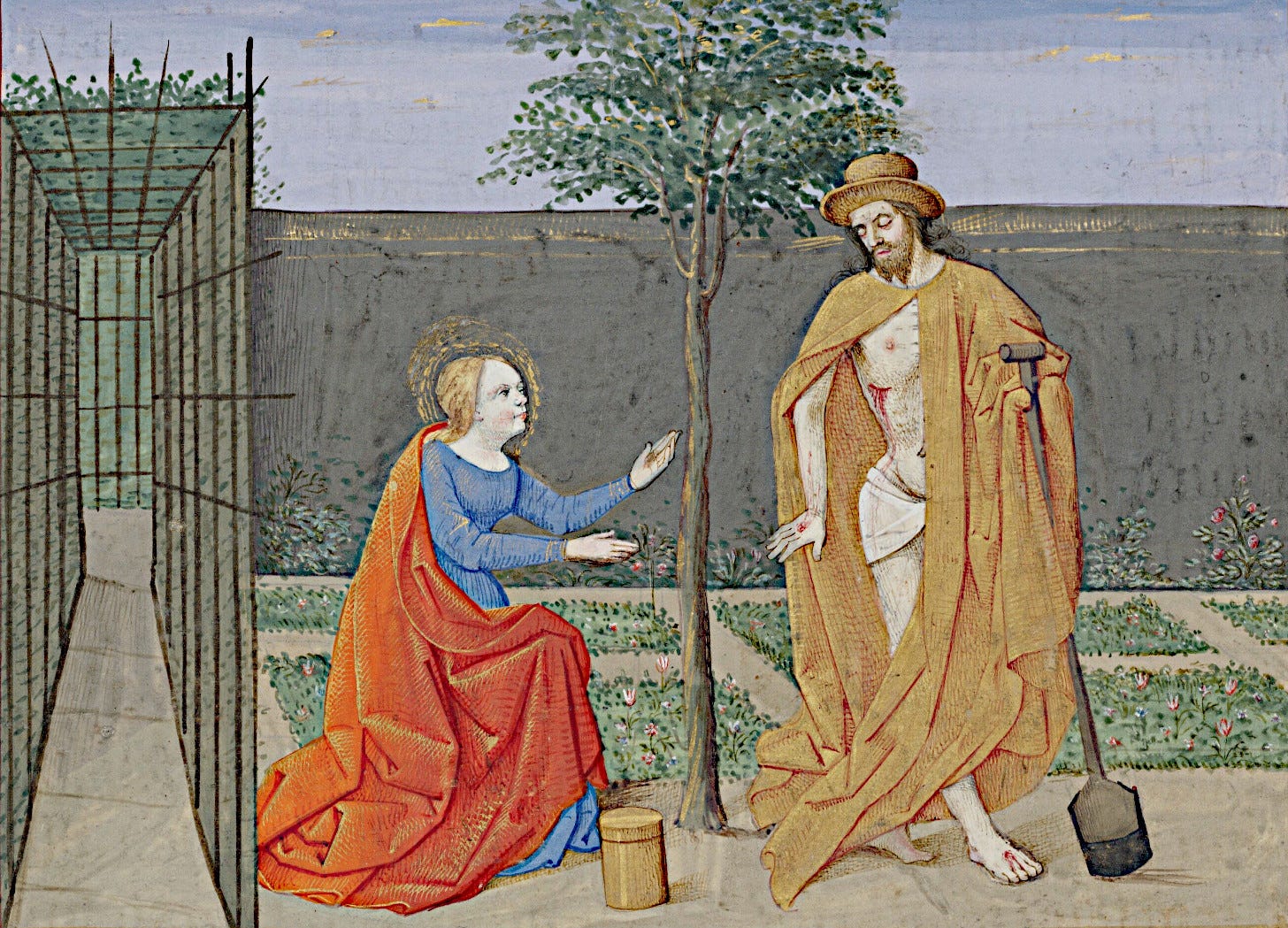
Among Jesus’ followers who witnessed His sacrifice on the Cross, St Mary Magdalene alone enjoyed a chance to speak with Christ in the garden (photograph above).[i] Wearing a wide-brimmed hat, Jesus holds a shovel and displays His wounds while draped in a golden cloak. This illuminator from fifteenth-century France layered post-Resurrection iconography to evoke how Magdalene, or Mary of Magdala, temporarily misperceived Him through her tears. “Supposing He was the gardener, she replied, ‘Sir, if you’ve removed Him, tell me where you’ve put Him, and I will take Him away.’” (John 20:15b, HCSB).[ii] When Jesus said her name, sorrow transformed into joy (John 20:16a). My article highlights a few key moments connected with Magdalene’s story, because today is a traditional vigil for the feast when Christians remember her devotion to God, 22 July.
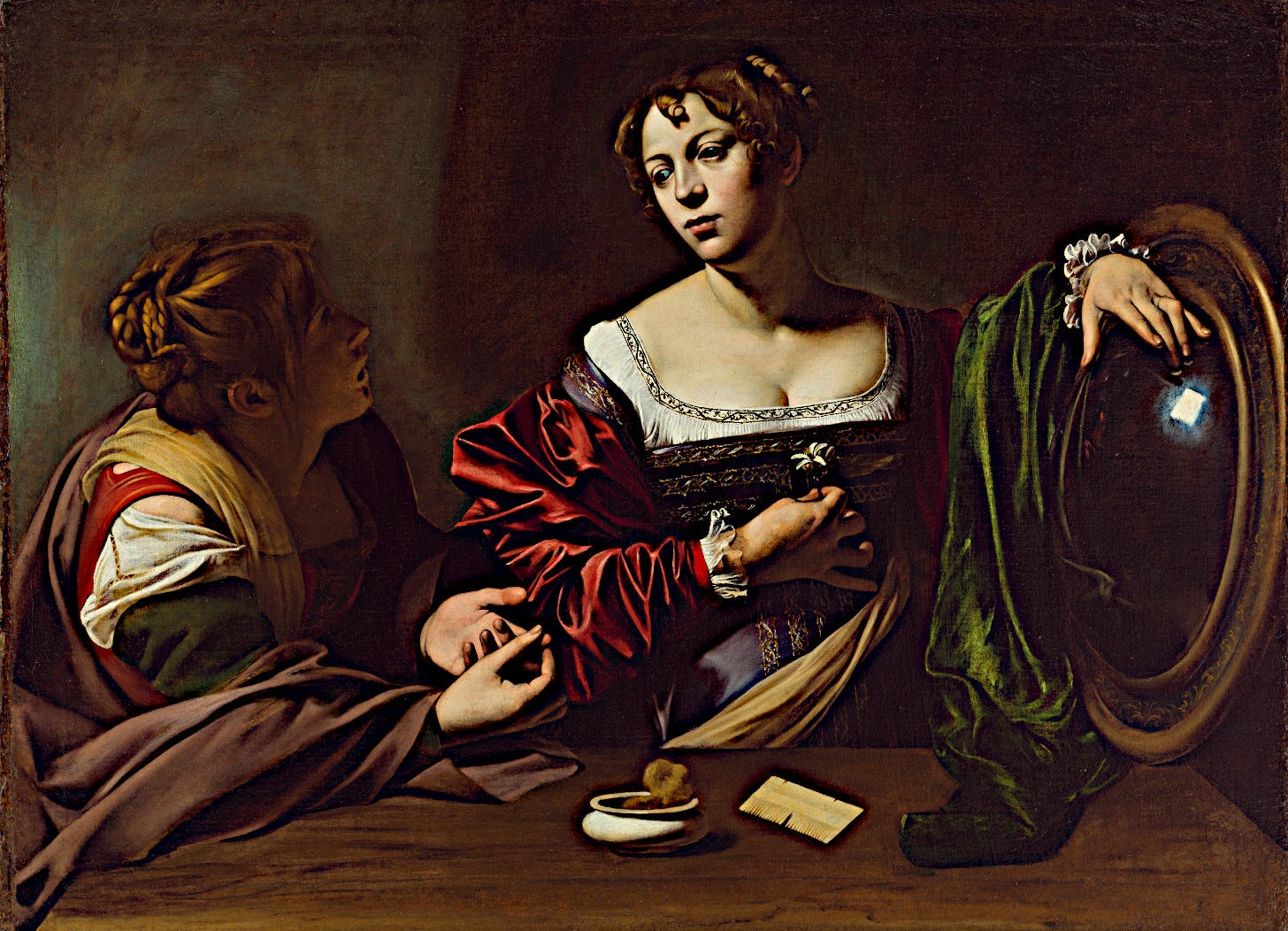
Caravaggio (1571-1610) reminded his audience of negative associations from Mary Magdalene’s past (Luke 8:2) in contrast to Martha’s more constant discipleship (illustrated above).[iii] Martha reasons with Mary in this scene, persuading her to shift focus from shallowness toward real substance. The large-scale convex mirror Mary holds while checking her appearance is anything but subtle. Although Caravaggio did not depict a Biblical episode, Gospel texts support characterizing Martha full of faith.[iv] For more than a millennium, many leaders, following Pope Gregory I the Great (c. 540-604), as well as medieval legends conflated Mary from Magdala with a woman who was Lazarus’s and Martha’s sister in Bethany.[v] Since my post’s medieval and Renaissance sources perpetuated a narrative that valued multifaceted connections over current distinctions, representations of both characters are included.
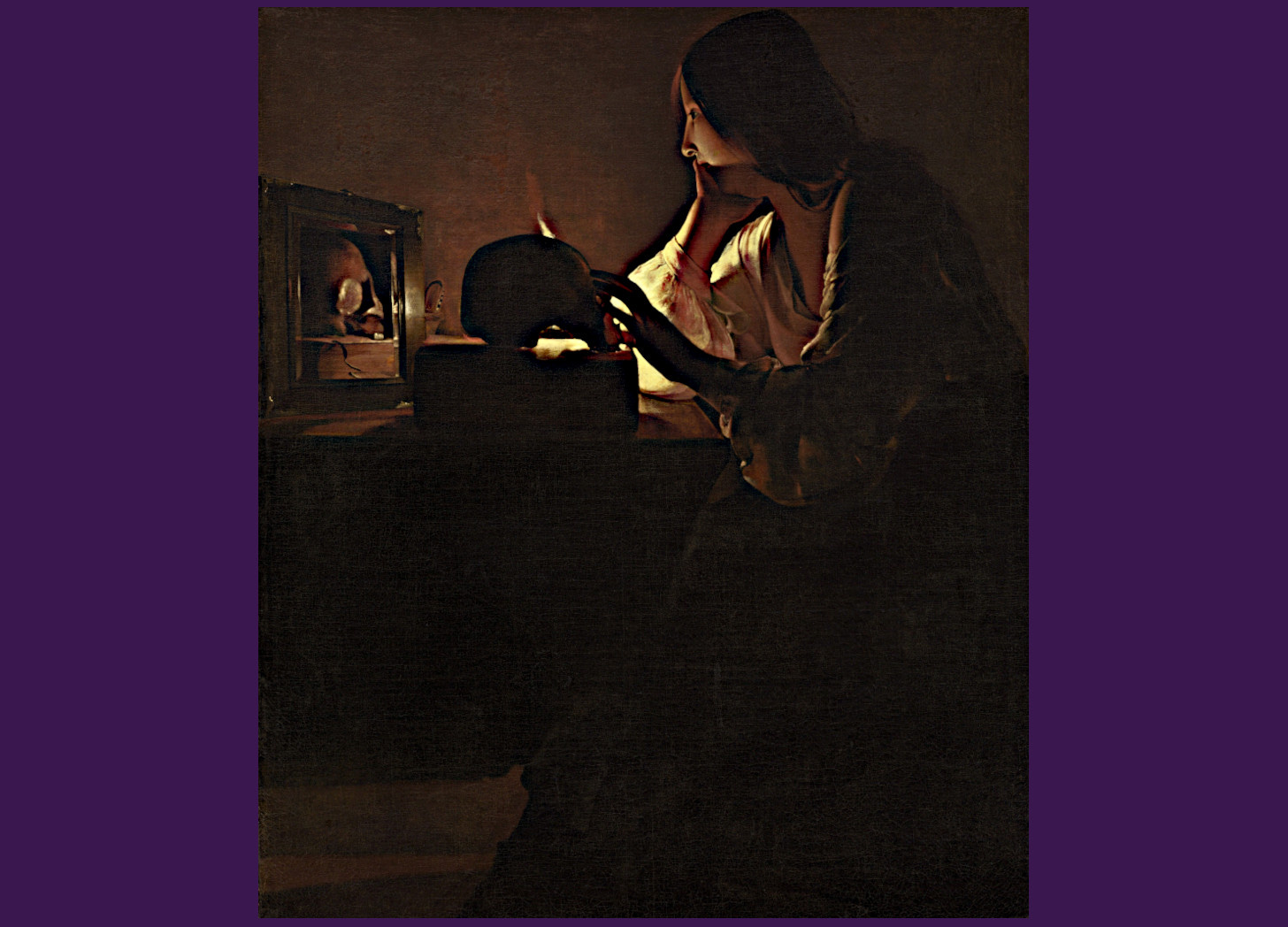
After Mary Magdalene truly recognized past transgressions, life completely changed. Aware of precarious mortality, she appears to focus on her soul’s eternal purpose instead of chasing transitory externals (photograph below).[vi] Georges de La Tour (1593-1652) painted Magdalene cradling her neck with the right hand and resting her left on a skull. Candlelight reveals wisps and locks of unfastened hair resting on a basic ivory garment. An empty, solid wood frame propped against the wall and aligned with her gaze appears to be a broken mirror. Old excesses and preoccupations have ended.
Magdalene’s dramatic lifestyle change brought a level of humility and devotion that made some people uncomfortable. When she, according to tradition,[vii] anointed Christ’s feet with expensive perfume, a Pharisee asked Jesus to send her away (Luke 7:36-39). The Lord refused, explaining that her radical experience of forgiveness, grace, and God’s love more than justified such a generous outpouring. Christ praised her and rebuked their cold hearts: “Therefore I tell you, her many sins have been forgiven, for she has loved much. But he who has been forgiven little loves little” (Luke 7:47, MSB).
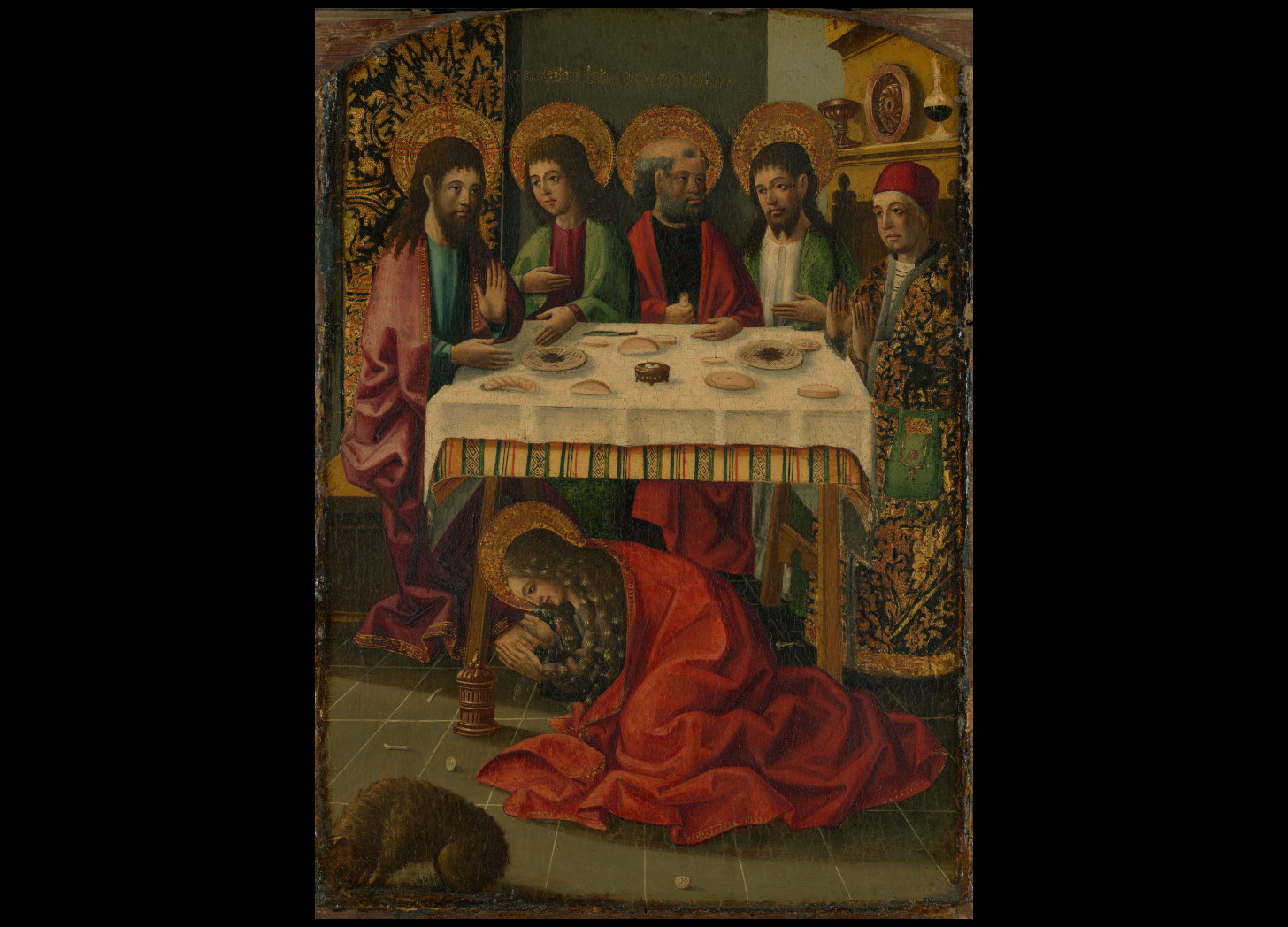
The Apostle-Evangelist John recorded a similar story when Mary of Bethany anointed Jesus using spikenard in Lazarus’s home while Martha served (John 12:1-11; see above). Her devotion could not be hidden: their “house was filled with the fragrance of the oil” (John 12:3b, NKJV).[viii] Christ’s own disciple, Judas Iscariot, complained how Mary had wasted resources that might have been donated to the poor. The Lord defended her and prophesied His death, “Leave her alone …. It was intended that she should save this perfume for the day of My burial. You will always have the poor among you, but you will not always have Me” (John 12:7-8, NIV).
Returning to my article’s first image, the encounter between Christ and Mary of Magdala gave her a special task. Jesus trusted Magdalene to communicate the wonderful update that He is alive, as predicted (Matthew 17:22-23). Sharing the Resurrection message with Christ’s closest followers transformed her legacy, because she has become known as “Apostle to the Apostles.”[ix] One of my Substack notes that encourages medieval paleography practice featured a fifteenth-century manuscript painting along with a Bible verse illustrating her choice to spread Good News (screenshot below left).[x]
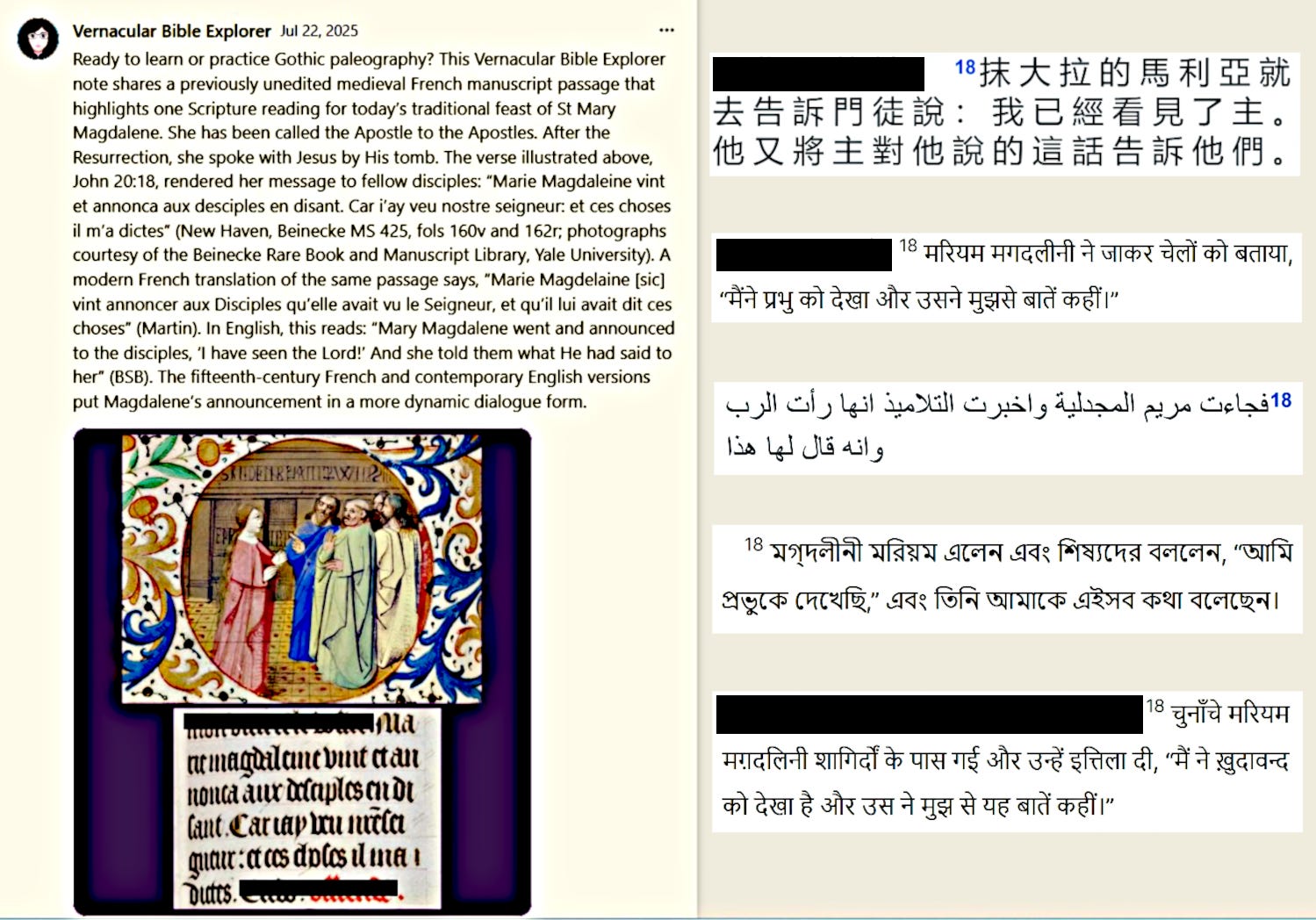
Mary Magdalene would probably have been with Jesus’ other disciples at Pentecost. Women were specifically cited in their group (Acts 1:14).[xi] Subsequent references about Christ’s followers remaining together support imagining brothers and sisters there (Acts 1:15-16 and 2:1). To reflect on spreading the Gospel using major vernaculars in our own time, translations of her post-Resurrection message in the globe’s top ten languages are listed here (image above right).[xii] An English rendering is: “‘I have seen the Lord!’ And she told them what He had said to her” (John 20:18b, BSB). In Spanish, Magdalene proclaimed: “¡He visto al Señor!, y que El le había dicho estas cosas.”[xiii] A French version says: “qu’elle avait vu le Seigneur, et qu’il lui avait dit ces choses” (Segond). Portuguese reads: “Vi o Senhor! - e que ele lhe dissera estas coisas.”[xiv] The Indonesian translation is: “‘Aku telah melihat Tuhan!’ dan juga bahwa Dia yang mengatakan hal-hal itu kepadanya.”[xv] Over five and a half billion people worldwide could recognize one of these verses.[xvi]
Would you like to see Magdalene’s news in any additional mother tongues? You are invited to leave a comment or request.[xvii] Please share your impressions of this material below. I also welcome posts that feature other works of art associated with Mary Magdalene.
[i] New Haven, Yale Missal, MS 425, Tours, France, 1470s, f. 285r. Many thanks for this photograph, courtesy of the Beinecke Rare Book and Manuscript Library, Yale University: https://collections.library.yale.edu/catalog/32465651, accessed July 2026.
[ii] Elsewhere in the codex, this artist showed Jesus as a gardener with a halo of golden rays; note f. 160v: https://collections.library.yale.edu/catalog/32465651, accessed July 2026.
[iii] A famous, English-language hagiographical account is found on pp. 45-53: https://ccel.org/ccel/v/voragine/goldleg4/cache/goldleg4.pdf. Caravaggio, Martha and Mary Magdalene, c. 1598, Italy, ac. no. 73.268. Grateful for the public domain photograph, courtesy of the Detroit Institute of Arts: https://dia.org/collection/martha-and-mary-magdalene/36204, accessed July 2026.
[iv] She told Jesus she knew He could have healed Lazarus, because she believed He’s the Messiah; John 11:21-27.
[v] An English translation of the homily is here: https://www.roger-pearse.com/weblog/2020/10/12/a-homily-of-gregory-the-great-and-mary-magdalene/. Also scroll down to check Magdalene references on pp. 187 and 199 at: https://dokumen.pub/forty-gospel-homilies-9781463217716.html, accessed July 2026.
[vi] Georges de La Tour, The Repentant Magdalen, France, c. 1635/40, ac. no. 1974.52.1. Thankful for this public domain image, courtesy of the National Gallery of Art, Washington, D.C.: https://www.nga.gov/artworks/54386-repentant-magdalen, accessed July 2026.
[vii] Please note that Luke did not equate the woman in this passage with Mary Magdalene. Modern commentators have recognized this distinction: https://www.biblegateway.com/resources/asbury-bible-commentary/k-the-women-8-1-3, accessed July 2026.
[viii] Master of Perea, St Mary Magdalen Anointing the Feet of Christ, Spain, c. 1500, ac. no. 1975.95.1. Perhaps this looks familiar, because it’s also part of an earlier VBE note: https://substack.com/@margarethadley358578/note/c-236528030?utm_source=notes-share-action&utm_medium=web. Appreciate a public domain illustration, courtesy of the Yale University Art Gallery: https://artgallery.yale.edu/collections/objects/14929, accessed July 2026.
[ix] https://www.vaticannews.va/en/saints/07/22/st--mary-magdalene--disciple-of-the-lord-.html and https://www.americanbible.org/engage/bible-resources/articles/mary-magdalene-apostle-to-the-apostles/, accessed July 2026.
[x] Many thanks for the public domain image courtesy of the Beinecke Rare Book and Manuscript Library from MS 425, f. 160v: https://collections.library.yale.edu/catalog/32465651. Also, find it at: https://substack.com/@margarethadley358578/note/c-137862683?utm_source=notes-share-action&utm_medium=web, accessed July 2026.
[xi] Commentaries have linked this reference with other proof texts in the Gospels (Matthew 27:55-56 and 28:1; Mark 15:40-41; Luke 8:2-3 and 23:49); an online example is: https://www.biblegateway.com/resources/reformation-study-bible/Acts.1.14, accessed July 2026.
[xii] Please find non-Roman scripts in the illustration. Verses are drawn from the following sites: https://cnbible.com/cu/john/20.htm, https://www.bible.com/bible/1980/JHN.20.IRVHIN, https://biblehub.com/arb/john/20.htm, https://www.bible.com/bible/1883/JHN.20.IRVBEN, and https://www.bible.com/bible/1885/JHN.20.IRVURD. Top ten lists differ. I used a recent one: https://www.ethnologue.com/insights/ethnologue200/, accessed July 2026.
[xiii] See https://bibliaparalela.com/lbla/john/20.htm, accessed July 2026.
[xiv] Find the entire chapter here: https://bibliaportugues.com/jfa/john/20.htm, accessed July 2026.
[xv] Search at: https://biblehub.com/tb/john/20.htm, accessed July 2026.
[xvi] https://www.statista.com/statistics/266808/the-most-spoken-languages-worldwide, accessed July 2026.
[xvii] Good places to locate less widely used translations are https://scriptureearth.org/ and https://fivefish.org/us, accessed July 2026.
This is an interesting post for me. I understood Mary Magdalene to have demons and that she wasn't on the shallow path on her own. I believe this is part of the Eastern Orthodox Church and early Christians.
Great post! The identification of Mary Magdalene with Mary of Bethany is also beautifully included in the Dies Irae: Qui Mariam absolvisti.