

Explorer’s Exhibit Series
Biblical Sources from Thirteen Original States

All of America’s original states are linked with Biblical works printed before or during the country’s first sixty years. This article presents thirteen Scripture-rich, vernacular sources as a miniature exhibition. Alongside many other similar objects, these primary documents represent ways people in the United States have been able to access and reflect on God’s Word.
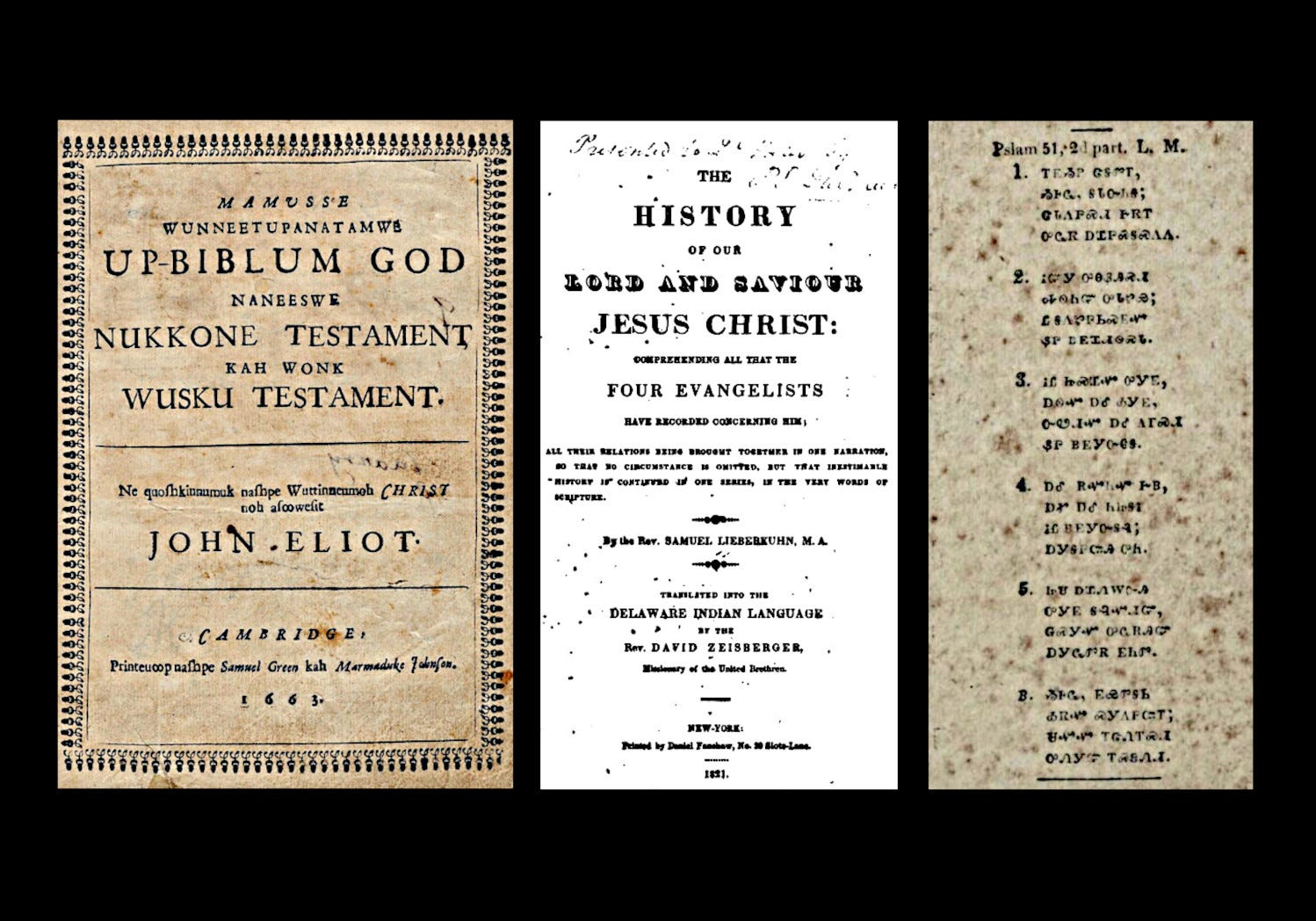
Since printing English Bibles was illegal throughout the colonies, the earliest complete copy of Scripture featured the Natick, Massachusetts, Wampanoag dialect of Algonquian (illustrated above left).[i] The Delaware Lenape Native American language was used to render Biblical texts and published in New York (see above center).[ii] The state of Georgia’s Cherokee Phoenix periodical included mother-tongue Scripture. Their fascinating syllabic alphabet facilitated translating the opening of Psalm 51 (image above right).[iii] An English version says: “Have mercy on me, O God, according to your unfailing love; according to your great compassion blot out my transgressions” (Psalm 51:1, NIV).
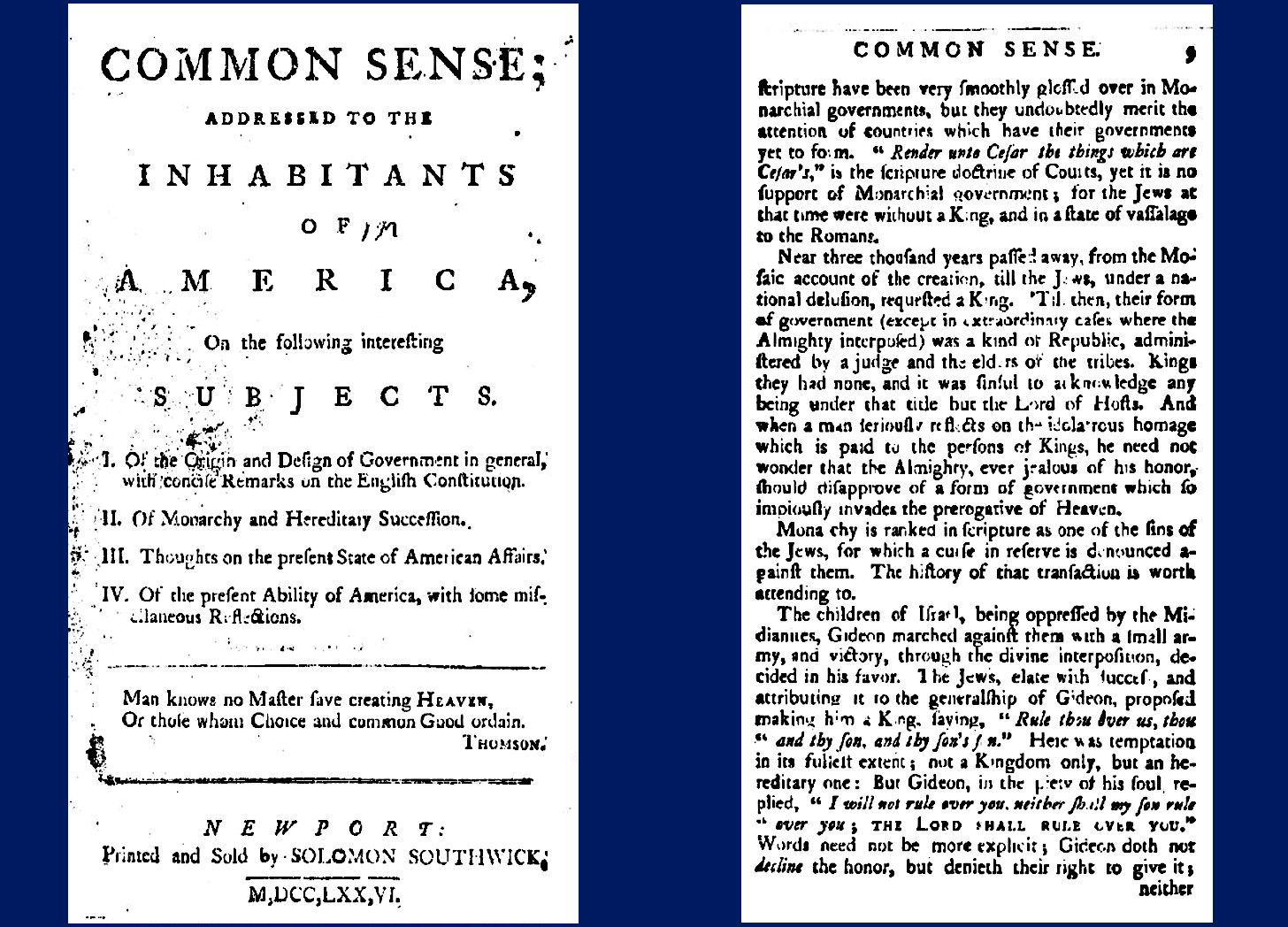
Calls for revolution were sometimes permeated with Biblical texts. For instance, Thomas Paine’s Common Sense was reprinted in Newport, Rhode Island, the year it appeared (find above, left and right).[iv] Paine repeatedly wove Scripture into the argument. While this rhetorical practice would currently be controversial, it strategically reflected the prevailing culture’s worldview. One example cited was Gideon’s refusal to accept kingship, when he had been called to lead as a judge: “I will not rule over you, neither shall my son rule over you: the LORD shall rule over you” (Judges 8:23, KJV).
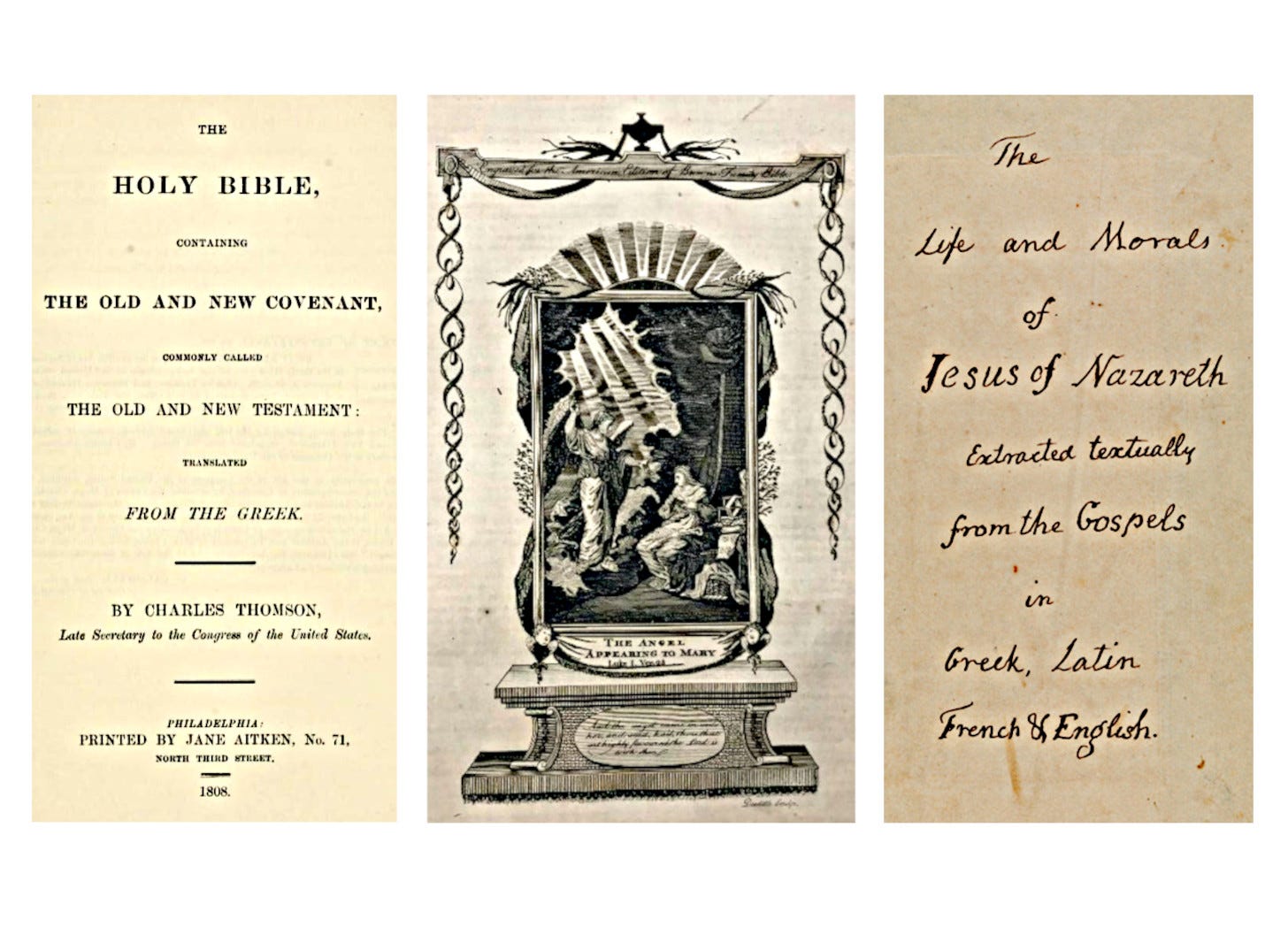
Robert Aitken of Philadelphia printed our country’s first lawful, English-language Bible.[v] Carrying on her father’s work, Jane Aitken published a new Scripture translation from Greek by Charles Thomson in 1808 (photographed, above left).[vi] George Washington subscribed to help bring Hodge and Campbell’s Bible to New York’s market (note above center).[vii] Washington probably received the first installment during 1790 while our country’s capital was still New York City. Thomas Jefferson chose excerpts from the Gospels to create a multilingual study compilation that he used for personal reflection at Monticello in Virginia (illustration above right).[viii]
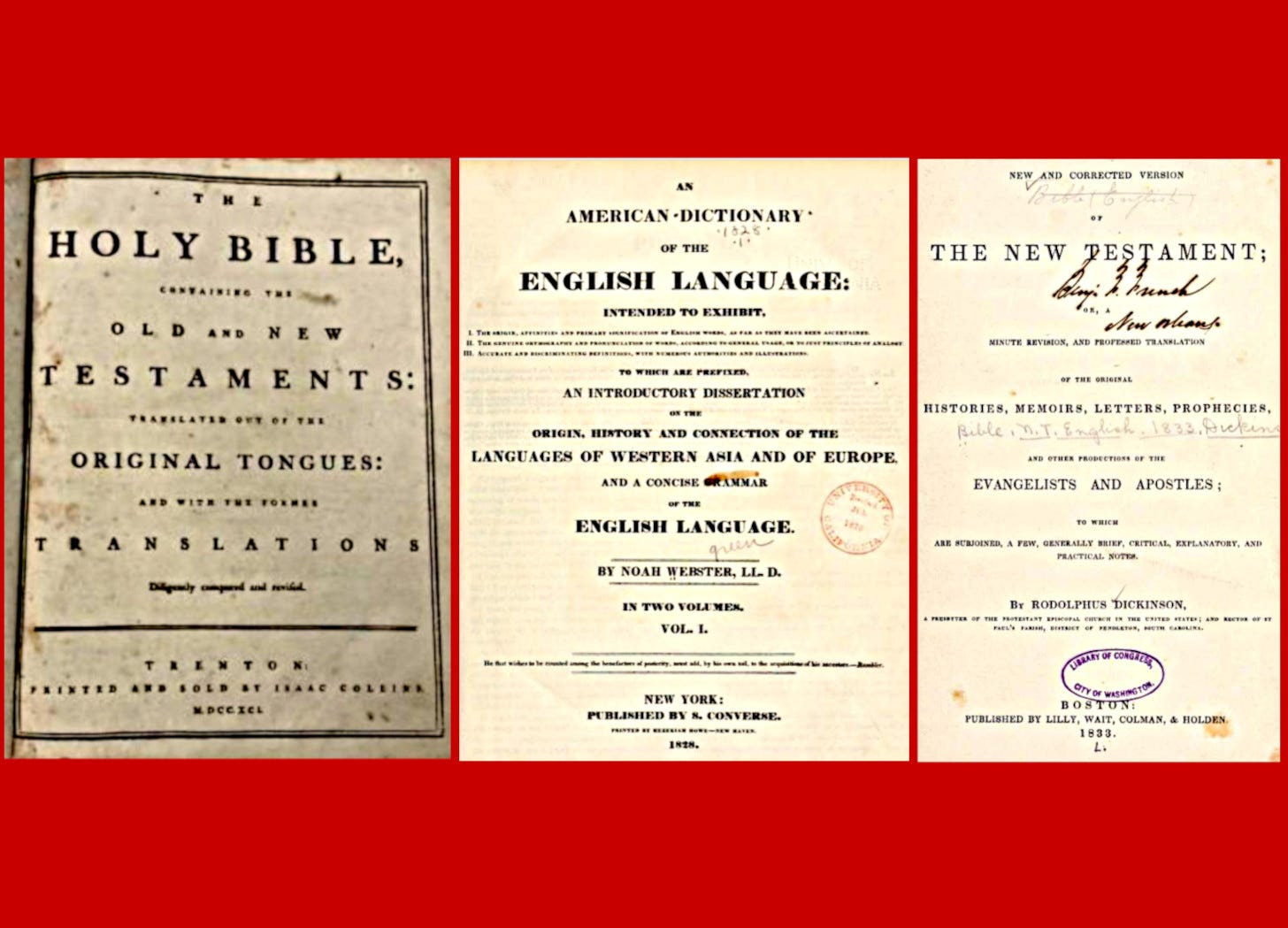
Careful revision distinguished the work of New Jersey’s Isaac Collins, who relied on help from John Witherspoon, president of the college that became Princeton (image above left).[ix] After applying what he learned at Yale by preparing a dictionary and popular spelling textbook, Noah Webster published an updated and more readable Scripture translation (see center, above).[x] Another attempt to correct the received, authoritative Biblical text was made by Rev. Rodolphus Dickinson of South Carolina and printed in Boston (note above right).[xi]
Concern for providing local copies of Scripture within reach of almost anybody prompted collaboration among those in the publishing world. Anselm Whipple’s New Hampshire edition involved a team, who made contributions throughout an extended timeline (photo below left).[xii] Hagerty’s refined diamond typeface for printing laypersons’ Bibles also foregrounded consumers’ needs (illustration, below center).[xiii] Its small-scale letters made a pocketsize format possible, which saved paper and helped limit costs.
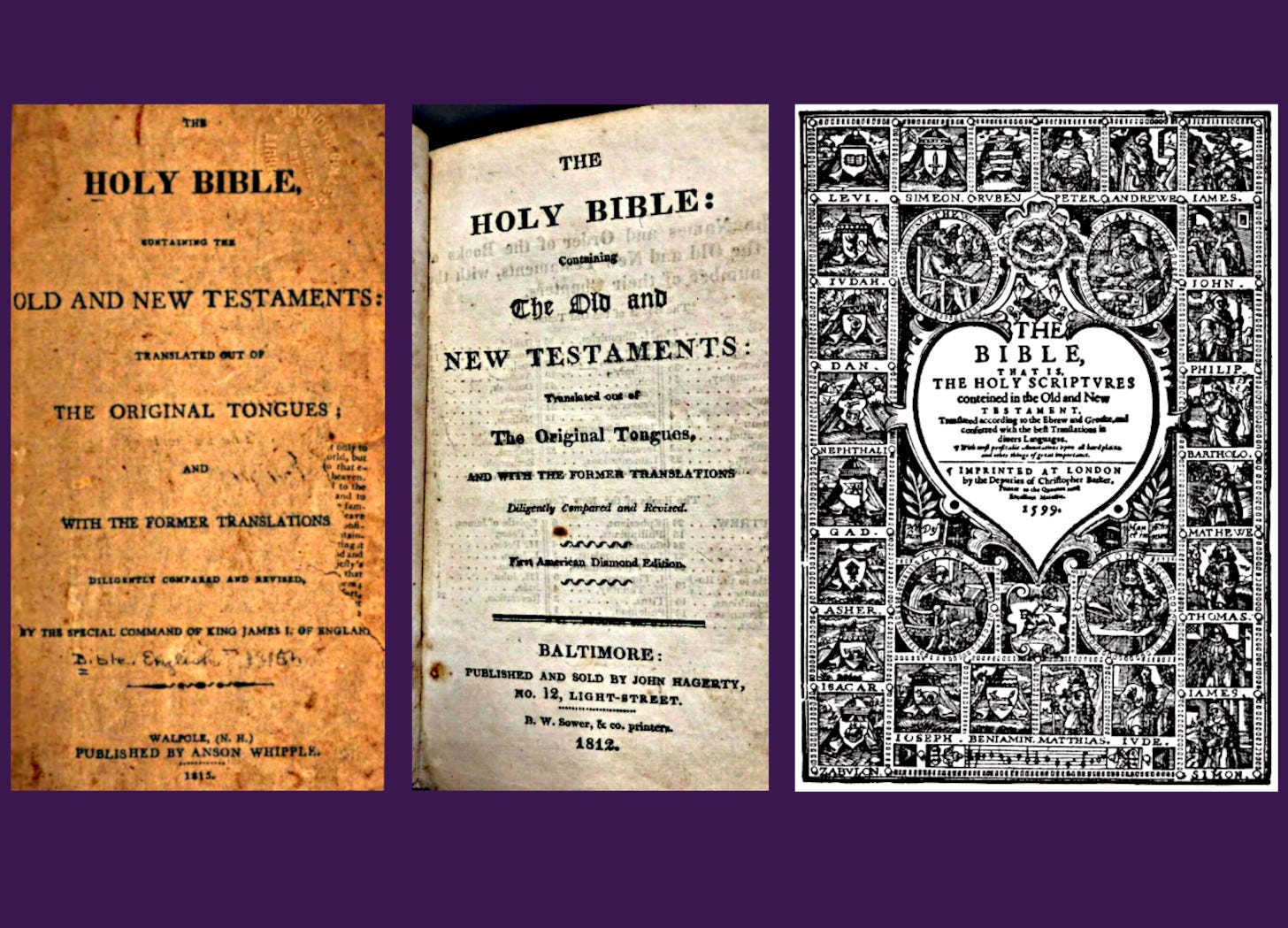
Early American Bible producers worked despite the availability of imported Scripture. A treasured copy of the 1599 Geneva Bible, which is still used for swearing in the University of North Carolina’s presidents, highlights another representative mode of access before and during the country’s early years (image above right).[xiv] Although Scriptures were regionally printed, many inhabitants continued to rely on European examples. Please post comments about other early books containing Biblical texts that are associated with America’s history. And I encourage you to share your reflections on the subjects covered here.
[i] If an example appeared in one of my past articles, please see the notes in that newsletter with detailed public domain illustration credits. For the 1663 Eliot Bible, read: https://vernacularbibleexplorer.substack.com/p/explorers-brief-survey-of-north-america, accessed June 2026.
[ii] Find the 1821 Delaware Lenape Gospels at: https://vernacularbibleexplorer.substack.com/p/episodes-in-us-bible-history, accessed June 2026.
[iii] Many thanks for this public domain image from the 3 April 1828 edition of New Echota Georgia’s Cherokee Phoenix, view 4: https://gahistoricnewspapers.galileo.usg.edu/lccn/sn83020866/1828-04-03/ed-1/seq-4/. A later New Testament translation (1860) is also available: https://babel.hathitrust.org/cgi/pt?id=njp.32101074870583&view=1up&seq=5, accessed June 2026.
[iv] To learn about its multiple printings, see: https://blogs.loc.gov/headlinesandheroes/2026/01/250-years-ago-thomas-paines-common-sense/ and https://history.house.gov/Blog/2026/January/1-8-Common-Sense/. Appreciate these public domain scans from the Early American Imprints database, accessed June 2026. References to Bibles printed in Rhode Island during the 1820s are found here: https://vernacularbibleexplorer.substack.com/p/rhode-island.
[v] Among many available introductions online, note this anniversary-themed example: https://celebratethebible250.com/2025/06/29/america-250-the-bible-of-the-american-revolution/, accessed June 2026.
[vi] https://vernacularbibleexplorer.substack.com/p/pennsylvania, accessed June 2026.
[vii] https://vernacularbibleexplorer.substack.com/p/new-york, accessed June 2026.
[viii] https://vernacularbibleexplorer.substack.com/p/virginia, accessed June 2026.
[ix] https://vernacularbibleexplorer.substack.com/p/new-jersey, accessed June 2026.
[x] For additional context, see: https://noahwebsterhouse.org/noah-websters-story/; https://vernacularbibleexplorer.substack.com/p/connecticut, accessed June 2026.
[xi] Grateful for the public domain illustrations of this 1833 Boston edition posted: https://archive.org/details/newcorrectedvers00bost/page/n5/mode/2up, accessed June 2026.
[xii] https://vernacularbibleexplorer.substack.com/p/new-hampshire, accessed June 2026.
[xiii] https://vernacularbibleexplorer.substack.com/p/maryland, accessed June 2026.
[xiv] https://www.unc.edu/posts/2024/10/11/historic-bible-will-be-part-of-chancellor-installation/; see a similar, public domain full digitization: https://archive.org/details/geneva-bible/mode/2up, accessed June 2026.
It does not surprise me that some people used verses from the bible for their political perspectives. It does surprise me that the colonies could not print English bibles.
I think that we can truly thank God for the spiritual foundation of our country.