

Explorer’s Challenge Series
Choosing Gospel Pericopes

Which passages from each of the four Gospels would you translate into a vernacular and share as widely as possible? My question could prompt many thoughtful, constructive responses. This article will rely on manuscript evidence to explain how Christians across Western Europe probably would have answered over 500 years ago.
During the late Middle Ages, laypersons’ most popular prayer collections were books of hours.[i] Since each volume was copied by hand, clients had multiple opportunities to personalize their devotional compendia, starting with the acquisition process.[ii] Among common New Testament texts were a series of Latin-language Scripture passages linked with major liturgical feasts. Specialists typically refer to standardized excerpts from each of the four Gospels in books of hours with a Greek-derived term: pericope.[iii] Under Charlemagne’s influence, a Synod of Tours (813) encouraged delivering vernacular sermons.[iv] Thereafter, Western European Christians regularly heard key preaching texts, like these pericopes, in both Latin and their mother tongues.[v]
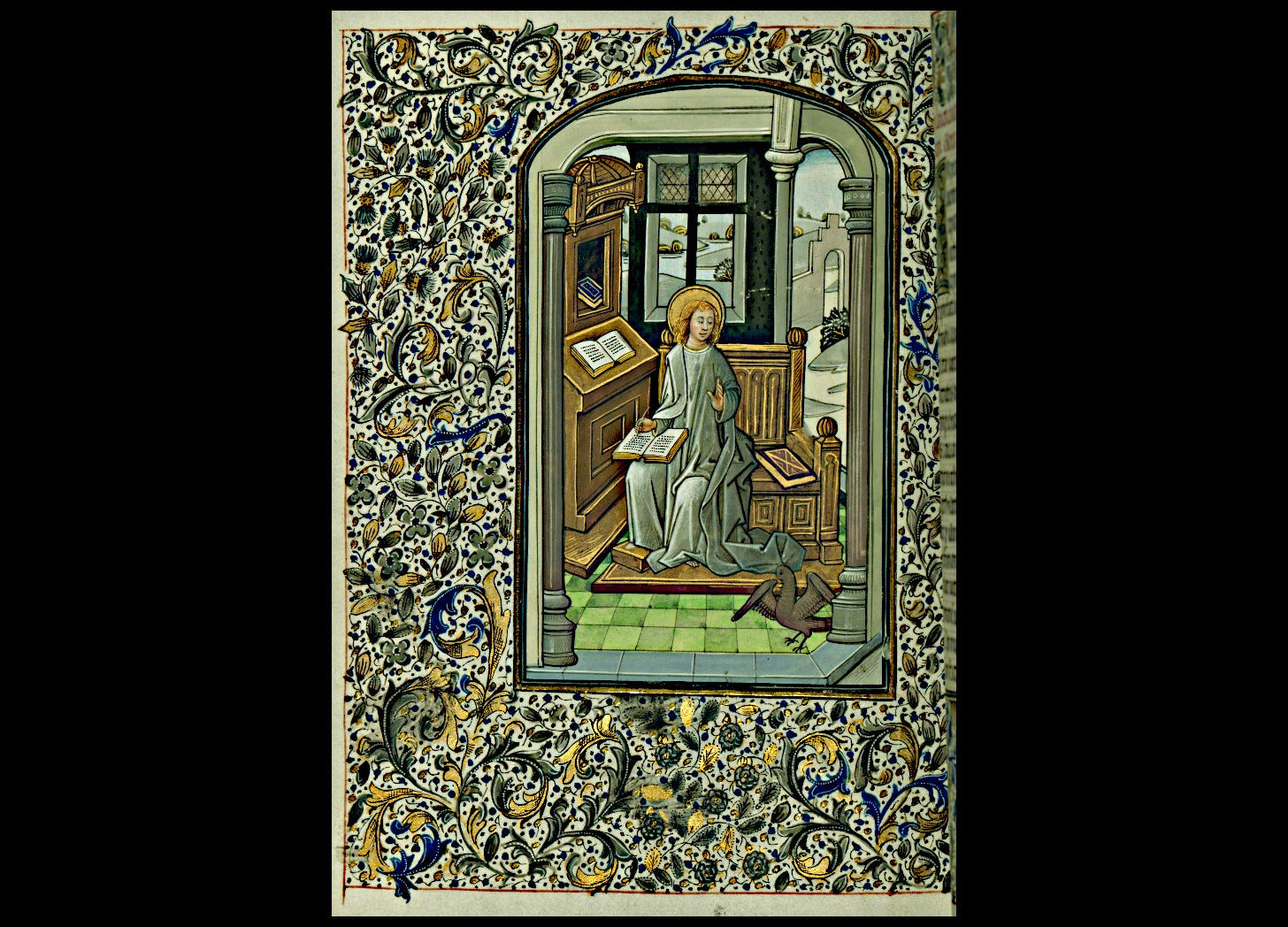
Providing a Gospel reading for Christmas day services, the standard four pericopes begin with the opening section of John (1:1-14; illustrated above).[vi] A miniature in the style of fifteenth-century Bruges’s Willem Vrelant shows the Apostle John looking toward an eagle, or his Evangelist symbol, at lower right.[vii] He paused from composing in a codex on his lap with an open tome on the desk and closed books on his seat as well as upper shelf. This artist represented John’s words as tiny minims.[viii] The Christmas passage starts: “In the beginning was the Word, and the Word was with God, and the Word was God” (John 1:1, KJV).[ix]
Luke the Evangelist’s account, linked to the Annunciation feast, began: “In the sixth month the angel Gabriel was sent by God …” (1:26a, NRSV; see also 1:26b-38).[x] While the saint’s ox—an iconographical attribute—appears to guard two volumes under the desk, Luke writes in a manuscript and keeps a codex open on his upper book stand (photograph below left).[xi] In this pericope, the Archangel Gabriel reassured the Virgin Mary: “For nothing will be impossible with God” (Luke 1:37, NET Bible).
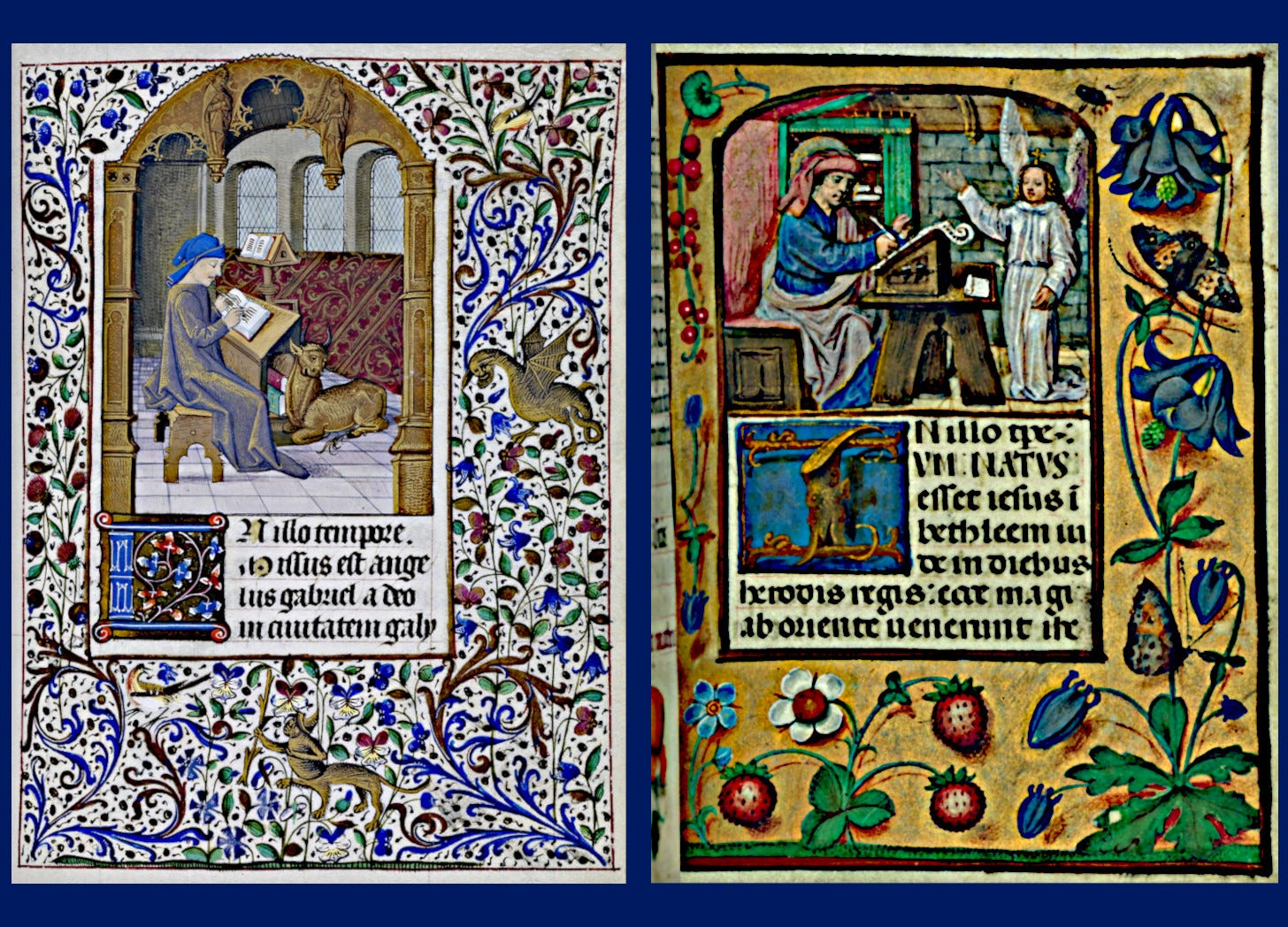
On the feast known as Epiphany (Matthew 2:1-12), medieval prayerbook owners attending services could have read how the wise men asked King Herod: “… Where is he that is born king of the Jews? For we have seen his star in the east, and are come to adore him” (Matthew 2:2. DRV). Berries, flowers, and insects, on gold, frame one manuscript’s depiction of the Apostle Matthew drafting a scroll (image above right).[xii] Crowned with a cross diadem, an angel, or Evangelist symbol, lifts his right arm in an oratorical gesture. One possible interpretation is that an angelic messenger provides Divine inspiration. Since the account itself features a guidance dream, which the following verse linked to an angel (Matthew 2:13), perhaps this image also evokes a specific passage from the pericope: “Being warned in a dream not to return to Herod, they went back to their own country another way” (Matthew 2:12, WEB).[xiii]
At the Ascension feast reading (Mark 16:14-20), Mark the Evangelist inspects his quill pen after writing a double opening of text with another codex on the stand (see below left).[xiv] His lion attribute displays an identifying scroll that says: “Sanctus Maercus [sic],” or St Mark. Curling gilt vines populate the scene’s background and inspired the conventional name for this Bruges workshop, the Masters of the Gold Scrolls.
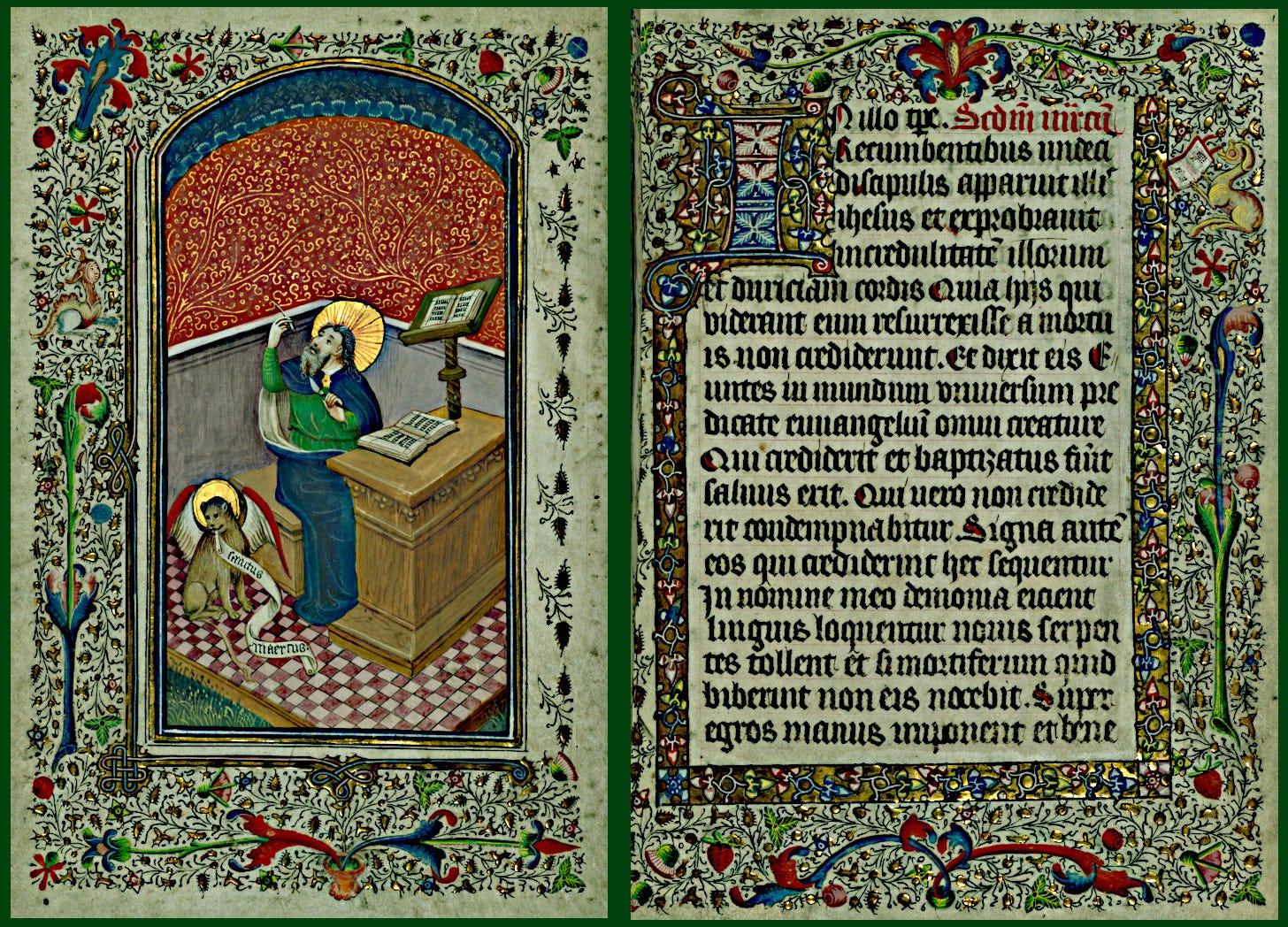
The adjacent text begins with a formula omitted by modern versions of the Vulgate, “In illo tempore,” or “At that time.” It continues: “… Recumbentibus undecim discipulis apparuit illis Ihesus: et exprobravit incredulitatem illorum et duriciam cordis. Quia hiis, qui viderant eum resurrexisse a mortuis, non crediderunt” (photograph above right).[xv] This translates: “Afterward he appeared to the eleven themselves as they were reclining at table, and he rebuked them for their unbelief and hardness of heart, because they had not believed those who saw him after he had risen” (Mark 16:14, ESV). The section’s central idea immediately follows: “Go into all the world and preach the gospel to all creation” (Mark 16:15, LSB).[xvi]
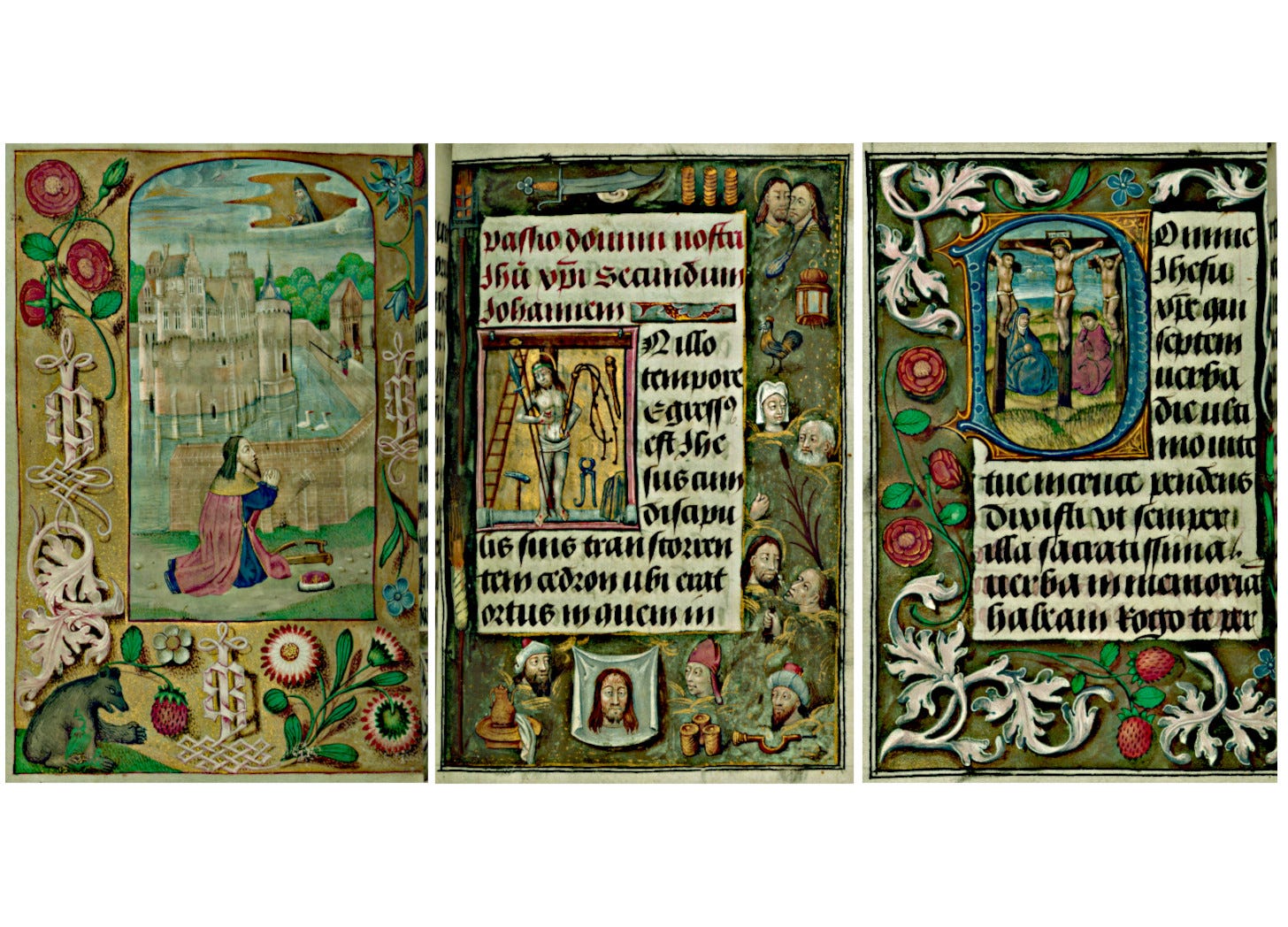
In a book made for Adolph of Ghent, Duke of Cleves, the Seven Penitential Psalms (photo above left) precede two texts containing verses drawn from Christ’s Passion (see above center and right).[xvii] The lengthiest Scripture excerpt is John chapters 18 to 19 (illustrated above center and below left).[xviii] Its artist thematically unified the program of illumination across this folio’s historiated initial and border, incorporating an elaborate series of references to the Arma Christi, or instruments of Jesus’ suffering.[xix] Displaying His side wound while holding a spear, lance, and flagellum, Christ stands on a fallen column in front of a T-shaped Cross that visually combine to form the text’s initial “I.” His gold ring halo encircles a green Crown of Thorns. Each wound continues to produce thin, light red streams of blood.[xx]
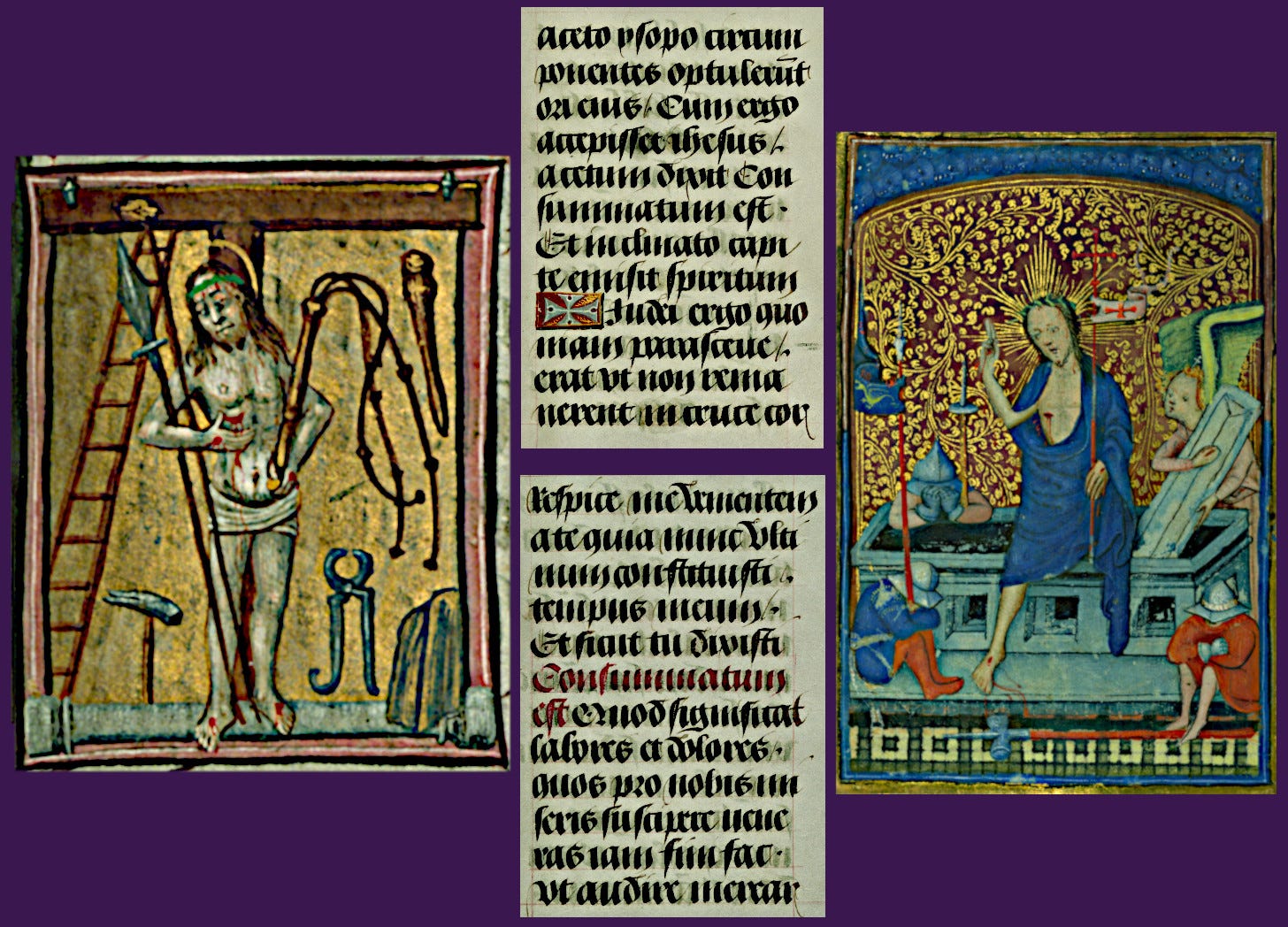
A cross, inserted in the text block, emphasized the moment when Jesus died. It appears two lines below His ultimate mortal words, penned with the manuscript’s usual ink color: “Consummatum est,” or “It is finished” (John 19:30b, ISV; upper center photograph above).[xxi] The following text features Christ’s seven statements from the Cross, but the scribe recorded His closing summary in red ink (see above, lower central text).[xxii] Cleves’s prayer book focused on Jesus’ sacrifice, but another fifteenth-century codex at the Walters Art Museum prefaced Christ’s Seven Last Words with a full-page miniature of the Resurrection (illustrated above right).[xxiii] Although the manuscript lacks a Biblical Easter account, this painting highlights the most consequential miracle throughout all four Gospels.
Reflecting on this traditional sequence of Scripture readings reveals essential strengths. New Testament passages that medieval laity could have had in their own library focused on Jesus’ identity, purpose, and message of God’s love for everybody.[xxiv] What other episodes would you add to the standard Gospel excerpts found in books of hours during the Middle Ages? Please post a list of verses you would share from each Gospel book. I look forward to your selections and other related comments.
[i] Scholars have called these manuscripts the medieval bestseller. Unfortunately, experts have not catalogued or even numbered all that survive. In A History of Illuminated Manuscripts, Christopher de Hamel wrote: “Books of Hours are now more widely scattered around the world than any other object made in the Middle Ages” (London: Phaidon, 1994), 2nd ed., p. 168.
[ii] Although certain prayerbooks were being readymade for the market by the Fifteenth Century, owners could always insert or overpaint sections to include portraits, names, family anniversaries, and additional texts.
[iii] https://www.merriam-webster.com/dictionary/pericope, accessed June 2026.
[iv] Specifically mentioned were “rusticam Romanam linguam aut Theotiscam” (chapter 10, the second paragraph of section 93), which developed into the languages of French, Italian, Spanish, and German: https://www.ccel.org/s/schaff/history/4_ch10.htm, accessed June 2026.
[v] Charlemagne encouraged the creation of a popular homiliary (797), associated with Paul the Deacon, that contains historic sermons and Biblical text sections for feasts throughout the liturgical year; https://www.ccel.org/ccel/schaff/encyc05/htm/iii.xiii.htm. One ninth-century copy at France’s National Library, MS lat. 12404, has been digitized, and its index begins here: https://gallica.bnf.fr/ark:/12148/btv1b105484836/f14.item.r=latin%2012404, accessed June 2026.
[vi] Baltimore, MS W.196, f. 44v, c. 1470, Bruges; cat. 94, pp. 213-14 in Roger Wieck, Time Sanctified: The Book of Hours in Medieval Art and Life (New York: George Braziller, Inc., 1988 and 2001). Many thanks for the public domain image courtesy of the Walters Art Museum: https://manuscripts.thewalters.org/viewer.php?id=W.196#page/94/mode/2up, accessed June 2026.
[vii] One hallmark of Vrelant’s work is a restrained palette that approaches grisaille, with primarily black-and-white tones.
[viii] Minims are basic vertical strokes that can be dotted as a minuscule “i” or mixed with other components to craft calligraphic letters.
[ix] “In principio erat Verbum, et Verbum erat apud Deum, et Deus erat Verbum” (Vulgate).
[x] “In mense autem sexto, missus est angelus Gabriel a Deo …” (Vulgate). This manuscript’s version begins with a general chronological formula, “In illo tempore …,” but the artist painted a large initial “L” instead of “I.”
[xi] Baltimore, MS W.249, f. 19r; c. 1470, France; Wieck 2001, cat. 49, pp. 192-3. Grateful for the public domain illustration online courtesy of the Walters Art Museum: https://art.thewalters.org/object/W.249.19R/. While an author portrait was the standard way to illustrate pericopes, some artists chose to represent Luke painting the Virgin Mary. London’s National Gallery has a panel with this iconography by Quinten Massys’s workshop: https://www.nationalgallery.org.uk/paintings/workshop-of-quinten-massys-saint-luke-painting-the-virgin-and-child, accessed June 2026.
[xii] Baltimore, MS W.427, f. 43r, c. 1500, Bruges or Ghent; Wieck 2001, cat. 103, p. 218. Thankful for the photograph provided courtesy of the Walters Art Museum: https://manuscripts.thewalters.org/viewer.php?id=W.427#page/88/mode/2up, accessed June 2026.
[xiii] “Et responso accepto in somnis ne redirent ad Herodem, per aliam viam reversi sunt in regionem suam” (Vulgate). This reading begins: “Cum ergo natus esset Jesus in Bethlehem Juda in diebus Herodis regis, ecce magi ab oriente venerunt Jerosolymam” (Matthew 2:1, Vulgate). The Baltimore manuscript added: “In illo tempore …,” and has a composite decorative initial “I” and “C” overlapping here.
[xiv] Baltimore, MS W.173, f. 13v, c. 1440-50, Bruges; Wieck 2001, cat. 89, pp. 211-12. Appreciate the public domain photo courtesy of the Walters Art Museum: https://manuscripts.thewalters.org/viewer.php?id=W.173#page/30/mode/2up, accessed June 2026.
[xv] The current Vulgate has some minor vocabulary, orthography, and phrasing differences: “Novissime recumbentibus illis undecim apparuit: et exprobravit incredulitatem eorum et duritiam cordis: quia iis, qui viderant eum resurrexisse, non crediderunt.”
[xvi] “Et dixit eis: Euntes in mundum universum prædicate Evangelium omni creaturæ” (Vulgate).
[xvii] Baltimore, MS W.439, ff. 204v and 266v, 1480s; Wieck 2001, cat. 98, pp. 215-16. Grateful for the public domain illustrations courtesy of the Walters Art Museum: https://manuscripts.thewalters.org/viewer.php?id=W.439#page/412/mode/2up and https://manuscripts.thewalters.org/viewer.php?id=W.439#page/536/mode/2up, accessed June 2026.
[xviii] Baltimore, MS W.439, f. 246r, 1480s. Thankful for the public domain image courtesy of the Walters Art Museum: https://manuscripts.thewalters.org/viewer.php?id=W.439#page/494/mode/2up, accessed June 2026.
[xix] When the text opening in a manuscript has an enlarged letter that frames a narrative or figural scene, specialists call this an historiated initial. An altarpiece with the Arma Christi can also be studied at the Walters Art Museum, see: https://art.thewalters.org/object/37.740/, accessed June 2026.
[xx] Other elements include a hammer, pinchers, a club to break legs (crurifragium; https://www.britannica.com/topic/crucifixion-capital-punishment, accessed June 2026.), the garment soldiers gambled to win, and a ladder. In the border, we see a lantern used to locate Christ in the Garden of Gethsemane, Peter’s sword and the High Priest’s servant’s severed ear, 30 coins, Judas’s betraying kiss, a rooster, Peter denying Jesus, a tormentor spitting on Christ, religious leaders, woodworking tools, three jars of ointment for burial, Veronica’s veil, and Pilate with the pitcher and basin to wash his hands.
[xxi] Baltimore, MS W.439, f. 263r, 1480s. Many thanks for the public domain image courtesy of the Walters Art Museum: https://manuscripts.thewalters.org/viewer.php?id=W.439#page/528/mode/2up, accessed June 2026.
[xxii] Baltimore, MS W.439, f. 270r, 1480s. Grateful for the public domain image courtesy of the Walters Art Museum: https://manuscripts.thewalters.org/viewer.php?id=W.439#page/542/mode/2up, accessed June 2026.
[xxiii] Baltimore, MS W.170, f. 144v, 1430-40, Ghent; Wieck 2001, cat. 84, pp. 209-10. Thankful for the public domain image courtesy of the Walters Art Museum: https://manuscripts.thewalters.org/viewer.php?id=W.170#page/290/mode/2up, accessed June 2026.
[xxiv] Famous Gospel accounts surrounding Jesus’ birth are also included in the Office of the Virgin: Luke 1:46-55 and 68-79; Luke 2:29-32. Hebrew Bible references were more plentiful, because other sections in medieval devotional books featured excellent models of Scriptural prayer found in the Psalms.
I think the words of the gospel that speak to me most and I would preach them to everyone today are: John 20:27-28: 27 Then he said to Thomas, “Put your finger here, and see my hands; and put out your hand, and place it in my side. Do not disbelieve, but believe.” 28 Thomas answered him, “My Lord and my God!”
Just before Jesus went back to heaven, He said, “And behold, I am with you always to the end of the age.” Matthew 28:20b
Also I think the decorated Scripture pages are beautiful.