


California entered the union on 9 September 1850.[i] Their region’s agricultural productivity significantly exceeds fellow states. Californians grow circa four hundred different commodities, including almost half of our vegetables and, according to their government’s summary, “over three-quarters of the country’s fruits and nuts.”[ii] This brief survey explores a few unique cases to evoke the state’s abundant Biblical history sources.
One finely illuminated copy of Gutenberg’s Bible, printed on vellum, passed through hands from Mainz to Wrocław and Prague to London until acquired by a New Yorker. Finally, it became part of the Huntington Library in San Marino (illustrated below).[iii] Johannes Gutenberg (c. 1400-68) pioneered printing with moveable type. He prepared some elite copies of the Latin-language Scriptures on the same parchment support used for fine fifteenth-century manuscripts, instead of relying only on paper. He left space for artists to add narrative and ornamental initials as well as border decoration. Extant copies from his press were usually completed by hand.[iv]
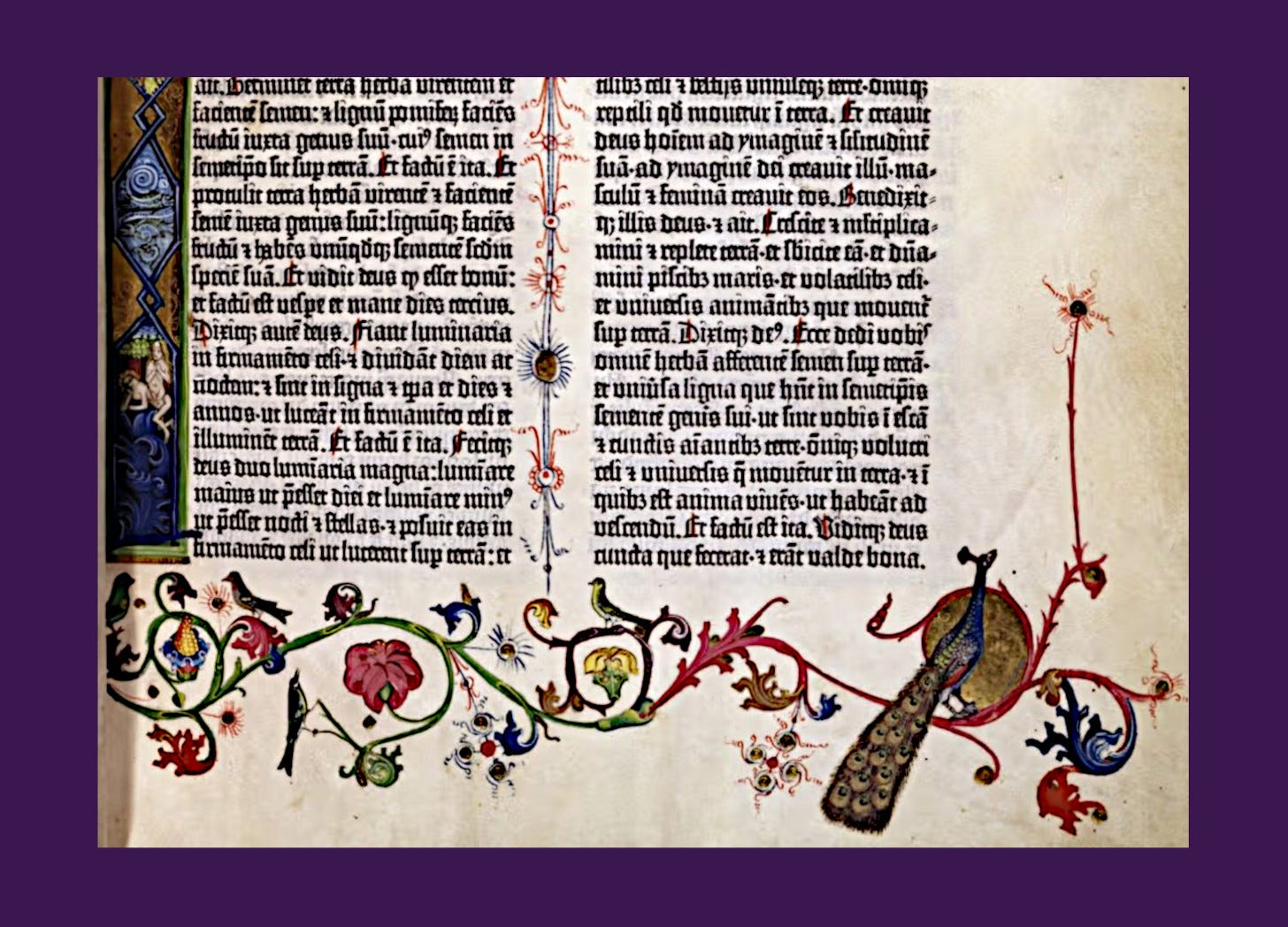
This detail from the Huntington’s Gutenberg Bible shows inhabited, multi-color acanthus leaves scrolling through the lower border of Genesis’s opening folio. A peacock, among other birds and flowers, enlivens marginal vegetation. Above the tall initial I’s framed depiction of Eve’s creation at left and penwork sunburst designs in the central margin, we read: “The earth brought forth vegetation, plants yielding seed according to their own kinds, and trees bearing fruit in which is their seed …. And God saw that it was good” (Genesis 1:12, ESV).[v]
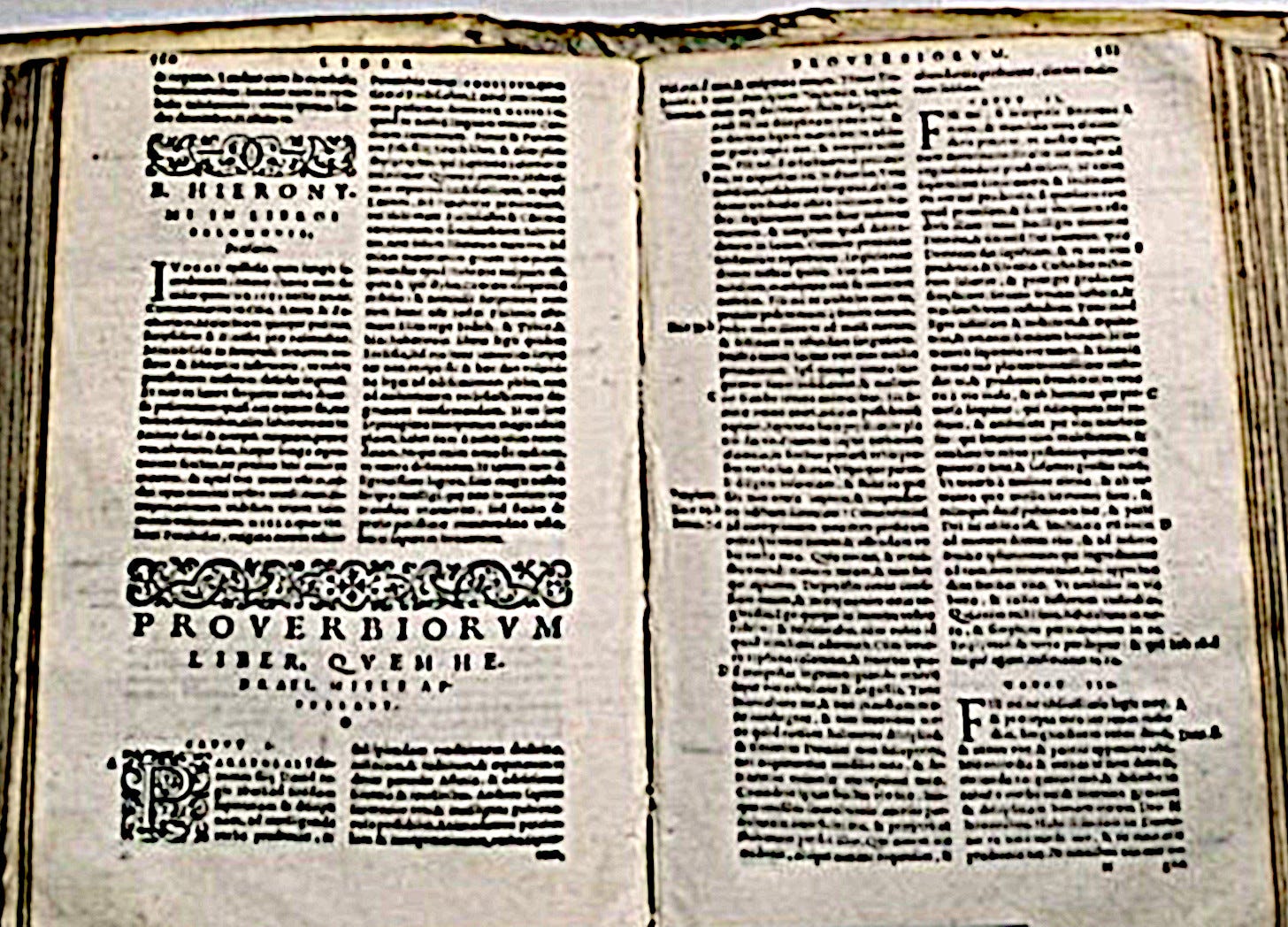
A previously treasured, vellum-covered Bible from Lyon, France (1568), has been in California since the 1700s (see above).[vi] It is linked with the Franciscan St Junípero Serra (1713-84). Several of the book’s inscriptions are attributed to this evangelist, whose motto was “always forward.”[vii] He may have brought his copy of Scripture from Mexico into California, where he founded nine missions. Among those related to major contemporary cities are San Diego, San Francisco, and San Carlos of Monterey-Carmel.[viii] One Latin-language verse from the illustration’s second column translates: “A wise person will hear and increase in learning, And a person of understanding will acquire wise counsel” (Proverbs 1:5, NASB).[ix]
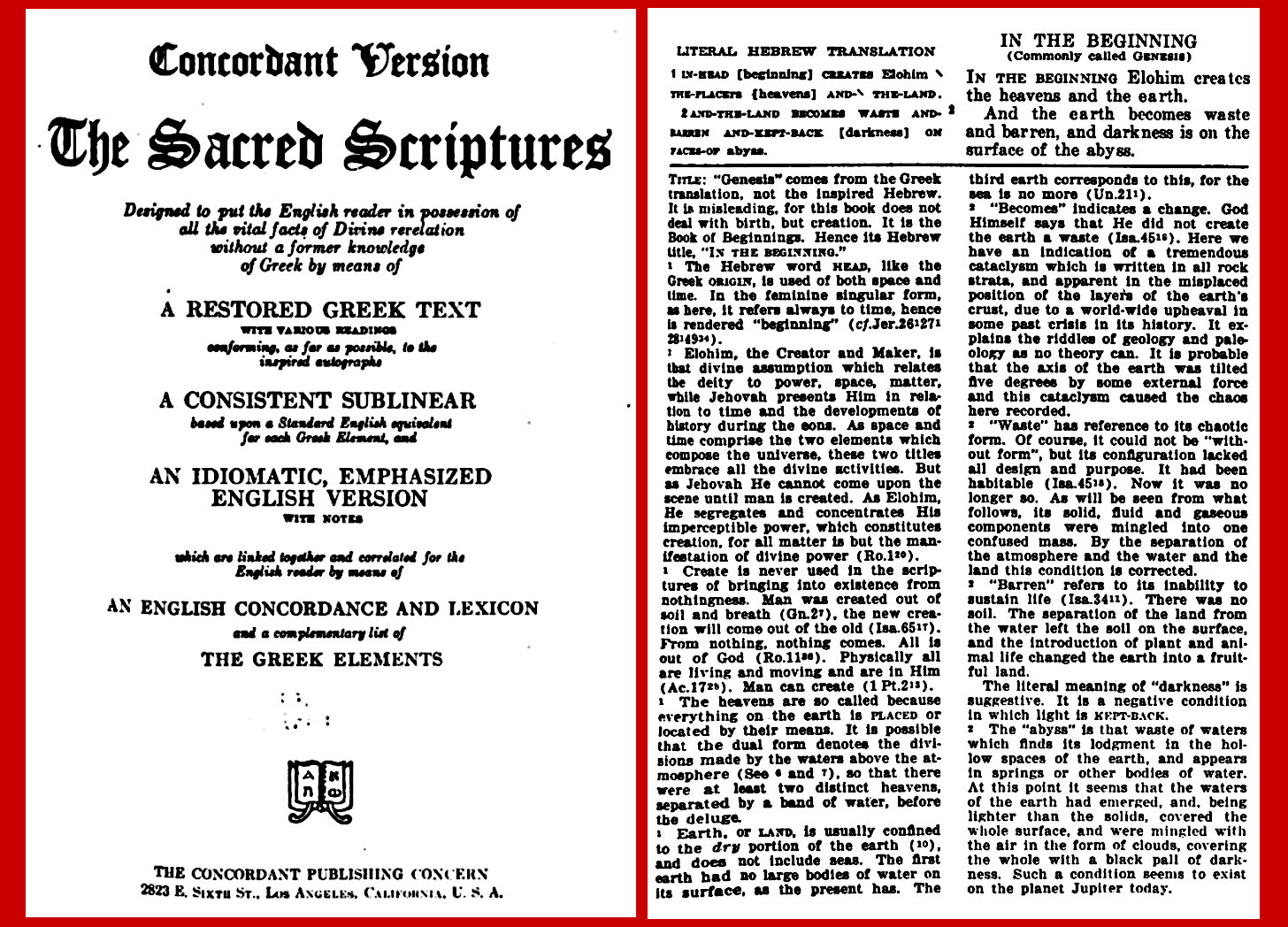
Adolph E. Knoch (1874-1965), a janitor-turned-publisher who graduated from Los Angeles High School, led a team’s painstaking labor over the course of decades to prepare his Concordant Version (images below).[x] Its English concordance included a comprehensive Biblical Greek vocabulary as well as grammatical information. At Genesis’s opening, its page format features a pair of verses above two columns of expansive notes (photograph below right).[xi] Knoch’s first explanation attempted justifying his decision to change the book’s name from a Greek-derived term: “In the Beginning (Commonly Called Genesis).” He also used “Elohim” rather than “God” (1:1).
Dr Gerritt Verkuyl (1872-1967) earned his Ph.D. from Leipzig and was a Princeton fellow. He translated the New Testament from the Tischendorf, Nestle, and Leusden Greek texts, while also comparing passages to the Septuagint and Aramaic versions. The original James J. Gillick edition published in Berkeley (1946) was corrected by 1947, then Zondervan took over its printing during the 1950s. Verkuyl rendered Scripture with a contemporary American style.[xii]
The University of California, Berkeley, was instrumental in founding Digital Scriptorium, a useful internet platform for scholars focused on extant primary sources.[xiii] Their forum features Biblical manuscript material, including fragments whose texts have significant amounts of Scriptural content. Please add examples to this discussion of California’s Bible history or share your thoughts about the material by posting a comment.
[i] Instead of passing through a federal territorial phase, the area was governed by our military after the Mexican-American War (1846-48). For background information, read: https://guides.loc.gov/mexican-war and, concerning how leapfrogging past territorial status was unusual, https://www.congress.gov/crs-product/R47747, accessed August 2026.
[ii] https://www.cdfa.ca.gov/Statistics/, accessed August 2026.
[iii] Many thanks for the photograph of this public domain work online: https://www.huntington.org/watch-read-listen/news/whats-hidden-gutenberg-bible and https://www.huntington.org/library/library-collections/gutenberg-bible, accessed August 2026.
[iv] Literature about Gutenberg is vast, and I won’t summarize it now. Here’s a short article that targets a few general misconceptions: https://www.history.com/articles/7-things-you-may-not-know-about-the-gutenberg-bible, accessed August 2026.
[v] The modern Vulgate version compares well with this book: “Et protulit terra herbam virentem, et facientem semen juxta genus suum, lignumque faciens fructum, et habens unumquodque sementem secundum speciem suam. Et vidit Deus quod esset bonum.” See https://biblehub.com/vul/genesis/1.htm, accessed August 2026.
[vi] Thankful for the illustration of this public domain book here: https://carmelmission.org/serras-bible/, accessed August 2026.
[vii] https://www.franciscanmedia.org/saint-of-the-day/saint-junipero-serra/, accessed August 2026.
[viii] Others were San Antonio, San Gabriel, San Juan Capistrano, San Luis Obispo, and San Buenaventura. Serra was canonized in 2015: https://www.usccb.org/offices/general-secretariat/saint-junipero-serra, accessed August 2026.
[ix] Or: “Audiens sapiens, sapientior erit, et intelligens gubernacula possidebit” (Proverbs 1:5, Vulgate); https://biblehub.com/vul/proverbs/1.htm, accessed August 2026.
[x] Margaret Hills, ed., The English Bible in America (New York: American Bible Society and New York Public Library, 1961) p. 360, no. 2250. For basic background, see https://www.concordant.org/expositions/faithful-laborers/e-knoch-memorial-part-one/ and https://www.concordant.org/about/founding-philosophy-and-mission/. Grateful for the public domain image of this work at: https://babel.hathitrust.org/cgi/pt?id=mdp.39015063880440&seq=9, accessed August 2026.
[xi] Appreciate the public domain image Hathi Trust posted: https://babel.hathitrust.org/cgi/pt?id=mdp.39015063880440&seq=65, accessed August 2026.
[xii] Please find a scan online: https://archive.org/details/holybiblenewberk0000unse/page/294/mode/2up. In an article about Biblical translation, Verkuyl highlighted challenges involved with translating; https://www.bible-researcher.com/verkuyl.html, accessed August 2026. Hills 1961, p. 398, no. 2437.
[xiii] https://digital-scriptorium.org/about/about-ds/ and https://manuscriptroadtrip.wordpress.com/2014/01/25/manuscript-road-trip-norcal/, accessed August 2026.
The illustrated Gutenberg Bible is a fine treasure indeed and I really do like the Proverbs photo as I reading that book in my personal study right now. Great choice of verse.
Very interesting read and so many people made sure the translation was there.