

Alabama
Episodes in U.S. Bible History

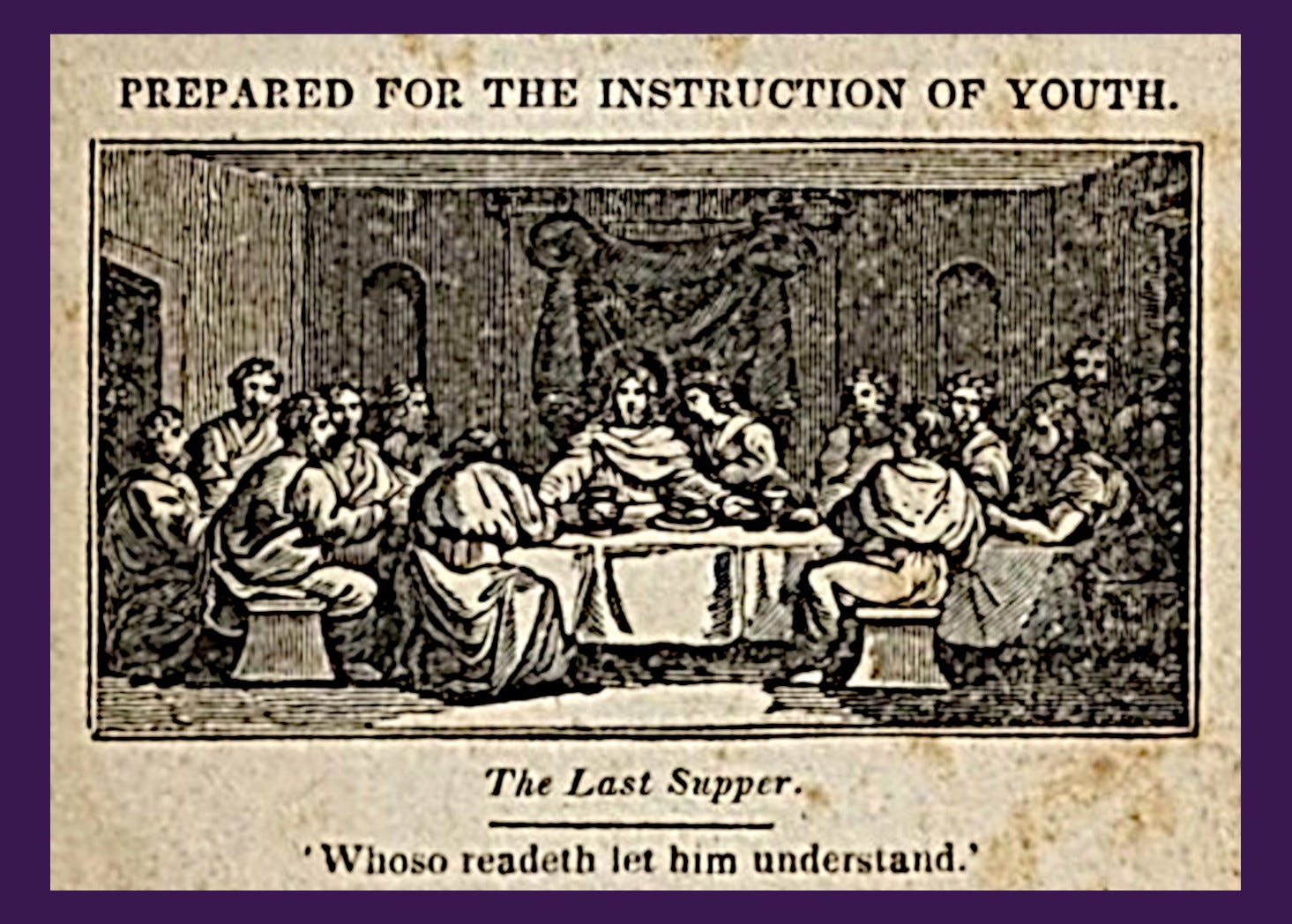
Alabama entered the union on 14 December 1819. Over a century earlier, Old Mobile had become the first permanent settlement on the Louisiana Territory’s Gulf Coast.[i] Before their administrative center shifted west again to Biloxi and then New Orleans, Mobile served as the French colonial capital from 1702 to 1711. Its prominence and ocean port facilitated a business relationship with the Connecticut publisher Silas Andrus (a. 1820s-50s).[ii] Among places Andrus’s 1831 edition of the New Testament could be purchased (illustrated above and below), we find a Mobile bookstore that Josiah Steele Kellogg (1803-82) started.[iii] Linked by waterways, this article will highlight Biblical sources used in Alabama’s former political capitals and university collections from its largest metropolitan area.
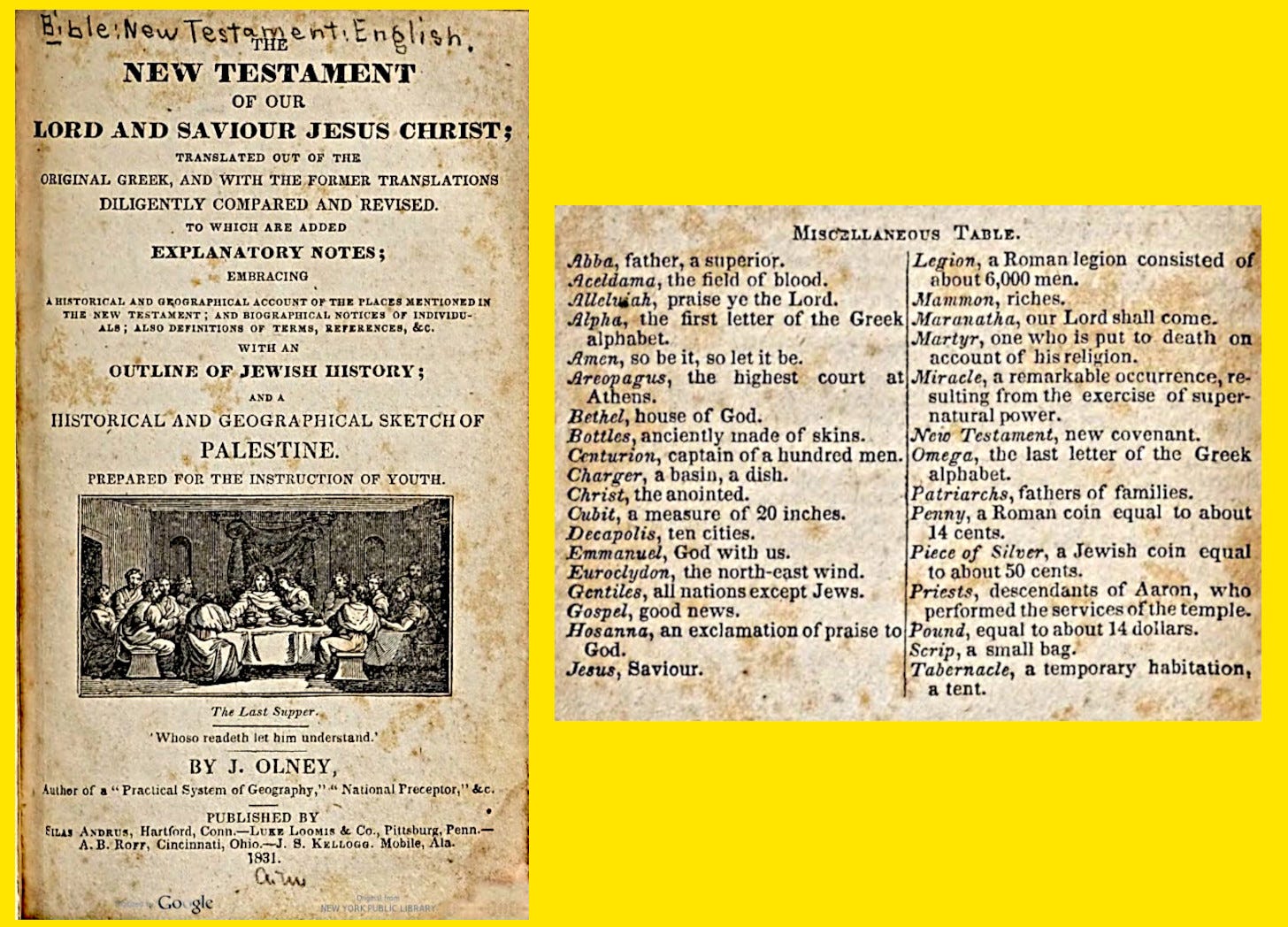
Jesse Olney (1798-1872) characterized his study Testament as “prepared for the instruction of youth.”[iv] Definitions, intended to clarify specific passages, accompanied pages of historical notes and prefaces. For instance, a “Miscellaneous Table” featured explanations of terms considered obscure (see above right).[v] One entry is Euroclydon, which is a furious wind mentioned in Acts 27:14.[vi] Due to its irresistible force, “When the ship was caught and couldn’t face the wind, we gave way to it and were driven along” (Acts 27:15, WEB). This type of north-easterly wind could even have been a concern for the Connecticut-based printer sending his wares to Mobile.
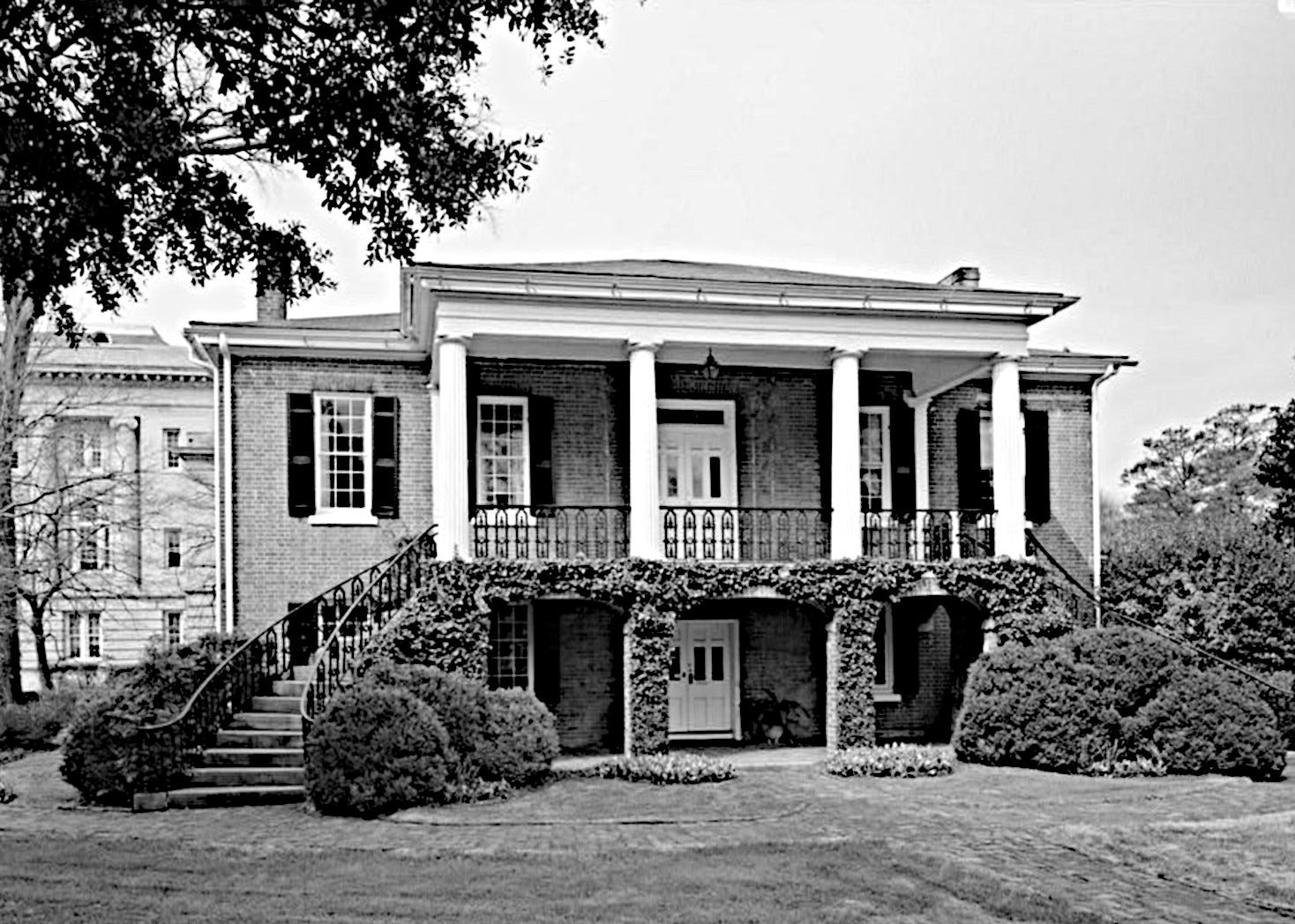
Joined with Mobile by rivers and a watershed, Tuscaloosa became Alabama’s state capital from 1826 to 1846.[vii] David Woodruff of Tuscaloosa (a. 1830s-60s)[viii] sold a complete Bible (1835), which Philadelphia’s Lawrence Johnson (1801-60) stereotyped and Alexander Towar (a. 1820s-30s) published.[ix] The edition also circulated via vendors in New York, Boston, and Pittsburgh. By 1835, Tuscaloosa was home to the state’s first public institution of higher education, the University of Alabama.[x] Towar’s printed Scriptures would have been marketed to scholars and general audiences.[xi] At the time of this publication’s arrival, their campus included what is now known as the Josiah Gorgas House, whose spaces served multiple purposes over the years from dining hall to hospital (image below).[xii]
Although not the most populous, Birmingham covers the largest area among Alabama cities and its people enjoy drinking water from Tuscaloosa’s Black Warrior River system.[xiii] Birmingham’s universities conserve a few manuscripts with Biblical texts. Samford University is home to several leaves from a collection of fragments once owned by Otto Ege (1888-1951).[xiv] One folio from an Italian prayer book shows the beginning of Psalm 27: “The LORD is my light and my salvation; whom shall I fear? [T]he LORD is the strength of my life; of whom shall I be afraid?” (KJV; photograph below left)[xv]
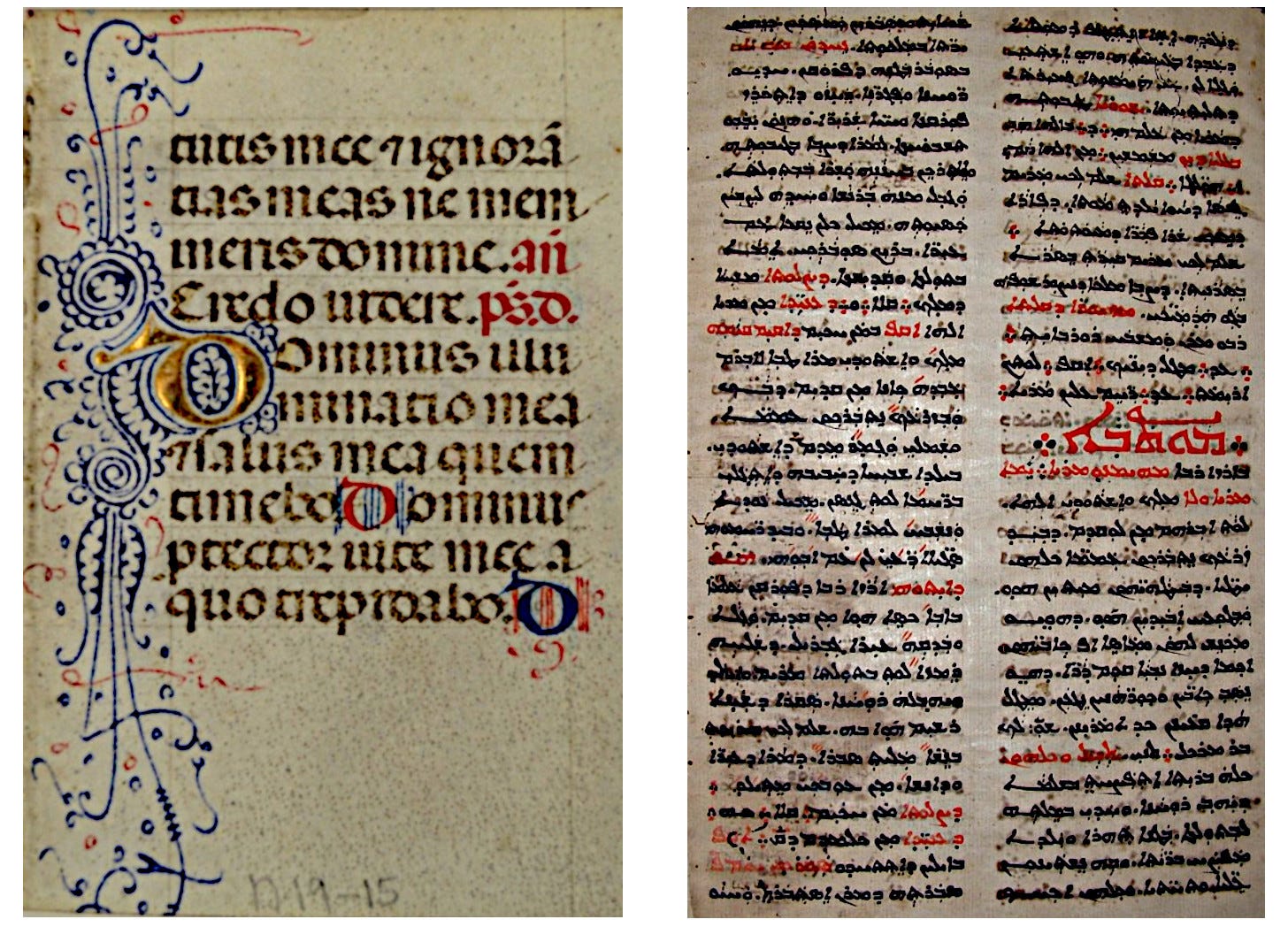
The University of Alabama at Birmingham’s library has a two-volume work of Christian prayers in Syriac dated 1589 (illustrated above right).[xvi] I hope scholars who can precisely describe these rare tomes and explain their textual content in detail will publish more about them. If you would like to add information on the history of Bibles in Alabama, please post below. I welcome comments about any aspect of this article’s material.
[i] https://www.nps.gov/subjects/nationalhistoriclandmarks/old-mobile-site.htm, accessed June 2026.
[ii] Silas Andrus may also have made a connection with Mobile’s Kellogg shop more directly through J.S. Kellogg’s upbringing in Hartford or Andrus’s 1830 Bible’s artist, Jarvis Griggs Kellogg (1805-73); https://books.google.com/books/about/The_Holy_Bible.html?id=TlzmyQEACAAJ. See p. 331 in https://dn720503.ca.archive.org/0/items/kelloggsinoldwor01hopk/kelloggsinoldwor01hopk.pdf. Search for Andrus’ last name at: https://norman.hrc.utexas.edu/Watch/fob_search_results_next.cfm?FOBFirmName=A&locSTARTROW=351, accessed June 2026.
[iii] J.S. Kellogg’s brief biography is found on p. 230 in: https://dn720503.ca.archive.org/0/items/kelloggsinoldwor01hopk/kelloggsinoldwor01hopk.pdf. A label from Kellogg’s store is found at: https://sevenroads.org/Labels/K.html. Many thanks for the public domain image at: https://babel.hathitrust.org/cgi/pt?id=nyp.33433100981194&seq=15, accessed June 2026.
[iv] https://catalog.hathitrust.org/Record/103361480, accessed June 2026.
[v] Grateful for this public domain scan online: https://babel.hathitrust.org/cgi/pt?id=nyp.33433100981194&seq=26, accessed June 2026.
[vi] https://www.biblestudytools.com/dictionary/euroclydon/, accessed June 2026.
[vii] https://blackwarriorriver.org/river-facts/ and https://encyclopediaofalabama.org/collection/state-capitals/, accessed June 2026.
[viii] David Woodruff’s close ties to the university are mentioned in their nineteenth-century register on pp. 21, 86, 107, 128, and 212: https://upload.wikimedia.org/wikipedia/commons/c/cc/A_register_of_the_officers_and_students_of_the_University_of_Alabama%2C_1831-1901._%28IA_registerofoffice00univrich%29.pdf, accessed June 2026.
[ix] Lawrence Johnson trained with B. & J. Collins, New York; see p. 313 at: https://books.google.com/books?id=nuc-AAAAYAAJ&pg=PA279&source=gbs_toc_r&cad=2#v=onepage&q&f=false. References to his former employer’s role in Bible history appear elsewhere on my Substack: https://vernacularbibleexplorer.substack.com/p/rhode-island and https://vernacularbibleexplorer.substack.com/p/vermont. Imperfect photographs of this work are available online: https://babel.hathitrust.org/cgi/pt?id=hvd.ah59ag&seq=9 and https://www.ebay.com/itm/298327277448?itmmeta=01KSX6NXCHZMV6TZPVAZC5C565&hash=item4575b0ff88:g:3HQAAeSwEPFqCiOc&itmprp=enc%3AAQALAAAAwDKQclQvzFwZQpmMrsO4LuoSL5f8BI3BP9w7Px%2B8DI%2FUwueifZiADHFQpZLPW0Z9SCmm1zpgDCzv78OA96p%2BIZ4E1IrkceDRKlOMXKE%2FGy2oSBUXXGMlZPFJ%2FOPvmJvduZlnlEtJy0Mm49dS1q7dedg09xWU4Hi%2F3lZ1yP6VRyoZtju5mdI8eXQXOM4ia69J2HyFbU40NqInWQ%2BFiLV7fo1e%2B3qT9RPZXHkxGOgkYwjyc%2FBvSAjBV7ZfJTfaxW%2Bs2Q%3D%3D%7Ctkp%3ABk9SR6zW16bPZw, accessed June 2026.
[x] It was chartered in 1820 and opened 1831; https://www.ua.edu/about/history/, accessed June 2026.
[xi] Here’s an historic advertisement for Woodruff’s bookstore in 1831: https://www.newspapers.com/article/alabama-state-intelligencer-david-woodru/195862429/, accessed June 2026.
[xii] Gorgas served as a Confederate officer before leading universities in Sewanee and Tuscaloosa; https://encyclopediaofalabama.org/article/josiah-gorgas/. This site of their nineteenth-century university president’s residence is open for visitors; see https://gorgashouse.museums.ua.edu/. Appreciate the public domain photograph: https://commons.wikimedia.org/wiki/File:Josiah_Gorgas_House_001.jpg, accessed June 2026.
[xiii] https://blackwarriorriver.org/river-facts/, accessed June 2026.
[xiv] https://library3.samford.edu/search/?searchtype=X&SORT=D&searcharg=otto+ege&searchscope=27; https://manuscriptroadtrip.wordpress.com/2014/08/07/manuscript-road-trip-sweet-home-alabama-and-georgia-too/. Ege did not hide his book breaking practices: https://blogs.loc.gov/loc/2021/03/another-little-piece-a-new-way-to-study-medieval-manuscript-fragments/. Many manuscript leaves, including Ege’s, are kept in Ohio; note: https://vernacularbibleexplorer.substack.com/p/ohio, accessed June 2026.
[xv] Thankful for this image of a public domain work at: https://manuscriptroadtrip.wordpress.com/wp-content/uploads/2014/08/l13.jpg, accessed June 2026.
[xvi] Appreciate the public domain images online. Note this photo in vol. 1 at view 11: https://uab.primo.exlibrisgroup.com/discovery/delivery/01AL_UALB:UAB_Libraries/12196669050003176. Links to both digitized volumes are found here: https://library.uab.edu/locations/reynolds/collections/medieval-renaissance-manuscripts, accessed June 2026.
Thank you for posting this. I enjoyed reading this and learning of the Christian prayers in Syriac dated 1589. I downloaded the free copies and will send them to our church's Bishop's Library.